
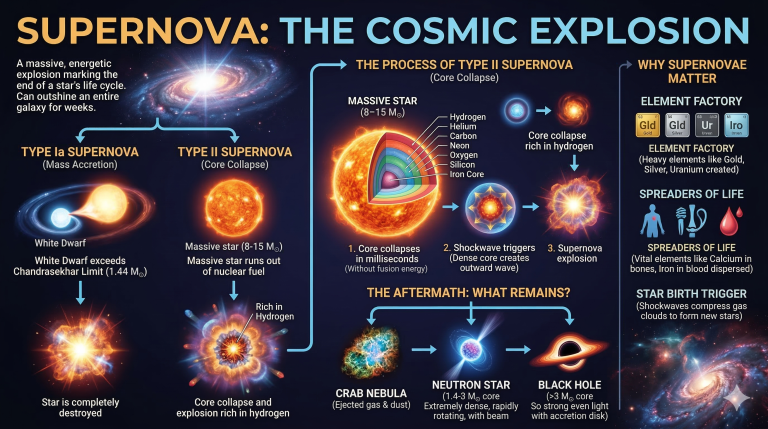
A supernova is one of the most energetic and spectacular events in the universe. Simply put, it is a giant explosion that marks the end of a specific star’s life cycle. This explosion is so bright that it can outshine an entire galaxy for several weeks or months.
Here is a complete guide to understanding these “cosmic fireworks”:
1. What Is a Supernova?
A supernova occurs when there is a drastic change in a star’s core. This can be triggered by two main mechanisms:
Mass Accretion (Type Ia): Occurs in binary star systems where a white dwarf “steals” matter from its companion star. If the white dwarf’s mass exceeds the Chandrasekhar Limit (approximately $1.44 M_{\odot}$), it explodes.
Core Collapse (Type II): Occurs in massive stars (at least $8$ to $15$ times the mass of the Sun) that run out of nuclear fuel. Without outward pressure from nuclear fusion, gravity causes the star’s core to collapse instantly.
2. The Process of a Supernova (Type II)
Massive stars spend their lives fusing light elements into heavier ones in their cores.
Layer Formation: The star begins to form onion-like layers of elements: hydrogen on the outside, followed by helium, carbon, neon, oxygen, and silicon.
Iron Core: The process stops at iron. Fusing iron does not produce energy; instead, it consumes it.
Core Collapse: Without fusion energy to counteract gravity, the core collapses in milliseconds.
Shockwave: The extremely dense core triggers a shockwave that travels outward, destroying the remainder of the star and ejecting it into space at thousands of kilometers per second.
3. The Aftermath: What Remains?
After the violent explosion, what is left behind depends on the initial mass of the star’s core:
Neutron Star: If the remaining core is about $1.4$ to $3$ times the mass of the Sun, it becomes an incredibly dense and rapidly rotating object.
Black Hole: If the remaining core is more than $3$ times the mass of the Sun, its gravity is so strong that even light cannot escape.
Supernova Remnant: The ejected gas and dust form beautiful nebulae, such as the Crab Nebula.
4. Why Are Supernovae Important?
Without supernovae, we might not be here. Here is why:
Element Factory: Supernovae are the birthplaces of heavy elements like gold, silver, and uranium.
Spreaders of Life: These explosions disperse vital elements (such as the calcium in our bones and the iron in our blood) across the universe.
Star Birth Trigger: The shockwave from a supernova can compress nearby gas clouds, triggering the formation of new stars and solar systems.
Quick Comparison: Type I vs. Type II
| Feature | Type I (Mainly Ia) | Type II |
| Trigger | White dwarf in a binary system | Single massive star |
| Hydrogen Content | No hydrogen spectral lines | Rich in hydrogen |
| Result | Star is completely destroyed | Neutron star or Black Hole |
Supernovae are proof that the death of one star is the beginning of millions of new possibilities in the universe.
Supernova adalah salah satu peristiwa paling energetik dan spektakuler di alam semesta. Secara sederhana, ini adalah ledakan raksasa yang menandai akhir dari siklus hidup sebuah bintang tertentu. Ledakan ini begitu terang sehingga bisa mengalahkan cahaya seluruh galaksi selama beberapa minggu atau bulan.
Berikut adalah panduan lengkap untuk memahami fenomena “kembang api kosmik” ini:
1. Apa Itu Supernova?
Supernova terjadi ketika ada perubahan drastis pada inti bintang. Hal ini bisa dipicu oleh dua mekanisme utama:
Pertambahan Massa (Type Ia): Terjadi pada sistem bintang biner di mana sebuah katai putih (white dwarf) mencuri materi dari bintang pendampingnya. Jika massa katai putih melampaui Batas Chandrasekhar (sekitar $1,44 M_{\odot}$), ia akan meledak.
Runtuhnya Inti (Type II): Terjadi pada bintang masif (setidaknya $8$ hingga $15$ kali massa Matahari) yang kehabisan bahan bakar nuklir. Tanpa tekanan luar dari fusi nuklir, gravitasi menyebabkan inti bintang runtuh seketika.
2. Proses Terjadinya Supernova (Type II)
Bintang masif menghabiskan hidupnya dengan menggabungkan elemen-elemen ringan menjadi lebih berat di intinya.
Pembentukan Lapisan: Bintang mulai membentuk lapisan-lapisan elemen seperti bawang: hidrogen di luar, diikuti helium, karbon, neon, oksigen, dan silikon.
Inti Besi: Proses berhenti pada besi. Fusi besi tidak menghasilkan energi, melainkan menyerapnya.
Keruntuhan Inti: Tanpa energi fusi untuk menahan gravitasi, inti runtuh dalam hitungan milidetik.
Ledakan Balasan: Inti yang sangat padat memicu gelombang kejut yang merambat keluar, menghancurkan sisa bintang dan melontarkannya ke luar angkasa dengan kecepatan ribuan kilometer per detik.
3. Hasil Akhir: Apa yang Tersisa?
Setelah ledakan dahsyat tersebut, apa yang tertinggal bergantung pada massa awal inti bintang:
Bintang Neutron: Jika sisa intinya sekitar $1,4$ hingga $3$ kali massa Matahari, ia akan menjadi objek yang sangat padat dan berputar cepat.
Lubang Hitam (Black Hole): Jika sisa intinya lebih dari $3$ kali massa Matahari, gravitasinya begitu kuat sehingga cahaya pun tidak bisa lepas.
Sisa Supernova (Remnant): Gas dan debu yang terlontar membentuk nebula yang indah, seperti Nebula Kepiting (Crab Nebula).
4. Mengapa Supernova Penting?
Tanpa supernova, kita mungkin tidak akan ada di sini. Berikut alasannya:
Pabrik Elemen: Supernova adalah tempat terciptanya elemen-elemen berat seperti emas, perak, dan uranium.
Penyebar Kehidupan: Ledakan ini menyebarkan elemen penting (seperti kalsium di tulang kita dan besi di darah kita) ke seluruh alam semesta.
Pemicu Bintang Baru: Gelombang kejut dari supernova dapat menekan awan gas di dekatnya, memicu pembentukan bintang dan sistem tata surya baru.
Perbedaan Cepat: Type I vs Type II
| Fitur | Type I (Terutama Ia) | Type II |
| Pemicu | Katai putih dalam sistem biner | Bintang masif tunggal |
| Kandungan Hidrogen | Tidak ada garis spektrum hidrogen | Kaya akan hidrogen |
| Hasil | Bintang hancur total | Bintang neutron atau Lubang Hitam |
Supernova adalah bukti bahwa kematian satu bintang adalah awal bagi jutaan kemungkinan baru di alam semesta.