
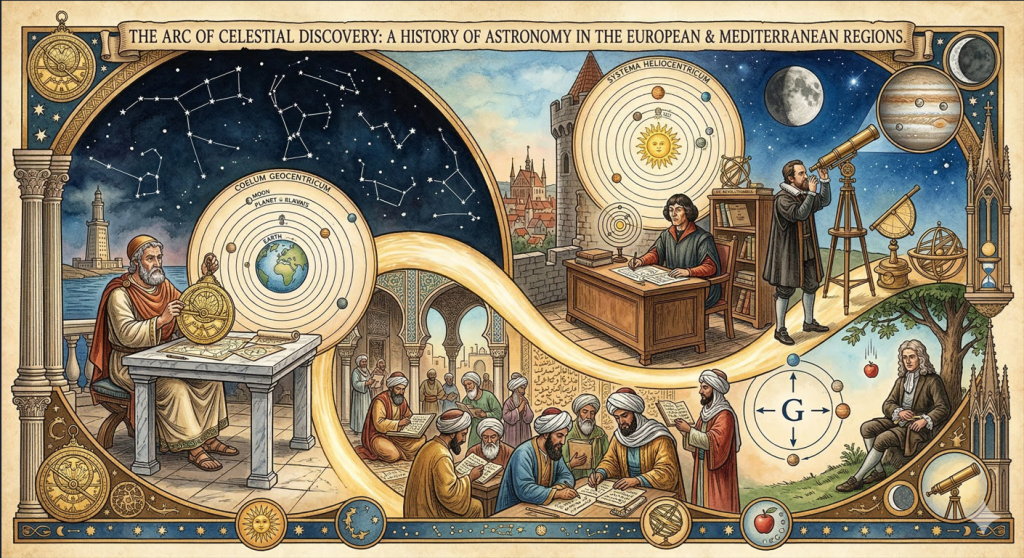
The history of the development of astronomy in the European and Mediterranean regions is one of the most influential chapters in the history of science. This region witnessed the shift of human thought from mythology to mathematical observation, ultimately giving birth to modern physics.
Here are the main stages of astronomical evolution in those regions:
1. The Ancient Era: Mediterranean Foundations
The Mediterranean coastal regions became the meeting point where observations of the sky began to be recorded systematically and analytically.
Egypt and Babylonia: These early civilizations mapped stars and planetary movements for calendar-making, seasonal predictions, and navigation. The Babylonians were the first to use recurring mathematical patterns to predict astronomical events like eclipses.
Ancient Greece (600 BCE – 150 CE): Greek thinkers brought a geometric approach to the heavens. Figures like Pythagoras and Aristotle formulated that the Earth was a sphere, not flat.
Ptolemy (2nd Century CE): Working in Alexandria (Egypt), he wrote a monumental work called the Almagest. He refined the Geocentric Model, which established that Earth sat at the center of the universe while the sun and planets revolved around it. He used complex calculations called epicycles to explain planetary motion. This model was dominant and believed in Europe for over 1,000 years.
2. The Middle Ages: Preservation and Innovation in the Islamic World
While Europe entered the Middle Ages and its scientific development slowed, the astronomical tradition was maintained and rapidly developed by Islamic civilizations, whose territory stretched around the Mediterranean, from the Middle East to Al-Andalus (Spain).
Translation Centers: Muslim scholars translated Ancient Greek texts, including Ptolemy’s works, into Arabic.
Observational Accuracy: They didn’t just copy; they tested. Scientists like Al-Battani measured the movement of the sun and the tilt of the Earth’s axis with much higher accuracy. They also perfected navigation and sky observation instruments like the astrolabe.
3. The Renaissance and the European Scientific Revolution (16th – 17th Century)
Arabic texts and Greek translations re-studied in Europe (primarily through Spain and Italy) sparked an intellectual revival that overturned humanity’s understanding of its position in the universe.
Nicolaus Copernicus: In 1543, this Polish astronomer published the Heliocentric theory, which radically placed the Sun—not the Earth—at the center of our solar system.
Tycho Brahe & Johannes Kepler: Brahe (Denmark) performed the most precise observations of the pre-telescope era. His assistant, Kepler (Germany), used that data to formulate the Laws of Planetary Motion, proving that planetary orbits are not perfect circles, but ellipses.
Galileo Galilei: This Italian physicist used the newly invented telescope to observe the sky. He discovered craters on the Moon, moons orbiting Jupiter, and the phases of Venus. These findings provided undeniable visual evidence that dismantled the ancient geocentric model.
Isaac Newton: At the end of the 17th century, this English scientist formulated the Law of Universal Gravitation. Newton successfully proved mathematically that the force making an object fall to the ground is the same pull that keeps planets in their orbits. This officially unified terrestrial physics with celestial physics.
The history in this region truly formed the foundation for the modern astrophysics we know today.
Perkembangan ilmu astronomi di wilayah Eropa dan Mediterania adalah salah satu babak paling berpengaruh dalam sejarah sains. Kawasan ini menjadi saksi pergeseran pemikiran manusia dari mitologi menuju pengamatan matematis, dan akhirnya melahirkan fisika modern.
Berikut adalah tahapan utama evolusi astronomi di kawasan tersebut:
1. Era Kuno: Pondasi Mediterania
Kawasan pesisir Mediterania menjadi titik temu di mana pengamatan langit mulai dicatat secara sistematis dan analitis.
Mesir dan Babilonia: Peradaban awal ini memetakan bintang dan pergerakan planet untuk tujuan pembuatan kalender, prediksi musim, dan navigasi. Orang Babilonia adalah yang pertama menggunakan pola matematika berulang untuk memprediksi peristiwa astronomi seperti gerhana.
Yunani Kuno (600 SM – 150 M): Pemikir Yunani membawa pendekatan geometris ke langit. Tokoh seperti Pythagoras dan Aristoteles merumuskan bahwa Bumi itu bulat, bukan datar.
Ptolemeus (Abad ke-2 M): Bekerja di Alexandria (Mesir), ia menulis karya monumental bernama Almagest. Ia menyempurnakan Model Geosentris, yang menetapkan bahwa Bumi berdiam di pusat alam semesta sementara matahari dan planet mengelilinginya. Ia menggunakan perhitungan rumit bernama epicycle untuk menjelaskan gerak planet. Model ini sangat dominan dan dipercaya di Eropa selama lebih dari 1.000 tahun.
2. Abad Pertengahan: Pelestarian dan Inovasi di Dunia Islam
Ketika Eropa memasuki Abad Pertengahan dan perkembangan sainsnya melambat, tradisi astronomi dijaga dan dikembangkan pesat oleh peradaban Islam yang wilayahnya membentang di sekitar Mediterania, dari Timur Tengah hingga Al-Andalus (Spanyol).
Pusat Penerjemahan: Ilmuwan Muslim menerjemahkan teks-teks Yunani Kuno, termasuk karya Ptolemeus, ke dalam bahasa Arab.
Akurasi Observasi: Mereka tidak hanya menyalin, tetapi juga menguji ulang. Ilmuwan seperti Al-Battani mengukur pergerakan matahari dan kemiringan sumbu Bumi dengan akurasi yang jauh lebih tinggi. Mereka juga menyempurnakan instrumen navigasi dan observasi langit seperti astrolab.
3. Renaisans dan Revolusi Ilmiah Eropa (Abad 16 – 17)
Teks-teks Arab dan terjemahan Yunani yang dipelajari kembali di Eropa (terutama melalui Spanyol dan Italia) memicu kebangkitan intelektual yang membalikkan pemahaman manusia tentang posisinya di alam semesta.
Nicolaus Copernicus: Pada tahun 1543, astronom Polandia ini menerbitkan teori Heliosentris, yang secara radikal menempatkan Matahari—bukan Bumi—sebagai pusat tata surya kita.
Tycho Brahe & Johannes Kepler: Brahe (Denmark) melakukan observasi paling presisi di era sebelum adanya teleskop. Asistennya, Kepler (Jerman), menggunakan data tersebut untuk merumuskan Hukum Gerak Planet, membuktikan bahwa orbit planet tidak berbentuk lingkaran sempurna, melainkan elips.
Galileo Galilei: Fisikawan Italia ini menggunakan teleskop yang baru ditemukan untuk mengamati langit. Ia menemukan kawah di Bulan, satelit alami yang mengelilingi Jupiter, dan fase-fase planet Venus. Temuan ini memberikan bukti visual tak terbantahkan yang menghancurkan model geosentris kuno.
Isaac Newton: Pada akhir abad ke-17, ilmuwan Inggris ini merumuskan Hukum Gravitasi Universal. Newton berhasil membuktikan secara matematis bahwa gaya yang membuat benda jatuh ke tanah adalah gaya tarik yang sama yang menahan planet-planet di orbitnya. Ini secara resmi menyatukan fisika Bumi dengan fisika langit.
Sejarah di kawasan ini benar-benar membentuk pondasi bagi astrofisika modern yang kita kenal sekarang.