
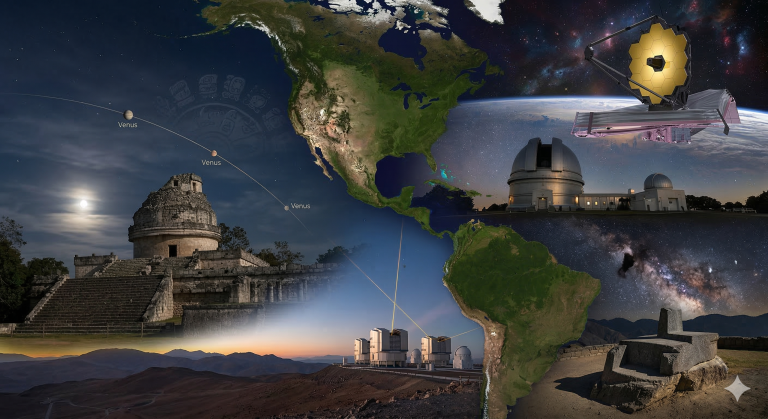
The history of astronomy in the Americas is a blend of highly accurate ancient wisdom and modern technological revolution.
Here is a summary of the historical development of astronomy in North, Central, and South America:
1. Central America (Mesoamerica)
Civilizations in this region, particularly the Maya and Aztecs, possessed some of the most advanced astronomical understanding in the world at the time.
The Maya: They developed complex calendar systems based on observations of Venus, the Moon, and the Sun. Observatories like El Caracol in Chichen Itza were built with windows aligned to specific astronomical events, such as the solstices.
High Accuracy: Mayan calculations of Venus’s orbit differ only slightly from modern calculations. For them, astronomy was both religious and a practical tool for agriculture.
2. South America
In the Andean region, the Inca Empire dominated celestial science with a unique approach.
The Inca: Unlike many cultures, they did not just identify constellations from star clusters; they also recognized “dark cloud” constellations within the Milky Way (such as the Llama constellation).
Intihuatana: These ritual stones were used to determine the exact dates of the solstices.
Modern Era (Chile): Today, South America—specifically the Atacama Desert in Chile—is the astronomical capital of the world. Due to its dry, clear skies, giant telescopes like the Very Large Telescope (VLT) and the upcoming Extremely Large Telescope (ELT) operate here.
3. North America
Development here is divided into the Indigenous phase and the modern scientific phase.
Indigenous Astronomy
Medicine Wheels: Tribes in the High Plains (such as in Wyoming) built circular stone structures to track the positions of specific stars and the summer solstice.
Chaco Canyon: The Ancestral Puebloan culture in New Mexico created architecture aligned with the 18.6-year lunar and solar cycles.
Modern Scientific Revolution
Since the 19th century, North America has become a leader in space exploration:
20th Century: The construction of massive observatories like Mount Wilson (where Edwin Hubble discovered the expanding universe) and Palomar.
The Birth of NASA (1958): Shifted astronomy from mere visual observation to physical exploration with the Apollo Moon missions, the Hubble Space Telescope, and the James Webb Space Telescope (JWST).
Comparison of Astronomical Focus
| Region | Primary Historical Focus | Major Contributions |
| North | Technology & Physical Exploration | Discovery of other galaxies, Moon landings, space telescopes. |
| Central | Calendars & Mathematics | Precision calculations of planetary orbits and ancient eclipse cycles. |
| South | Deep Sky Observation | Mapping of dark constellations and world-leading observatory hubs (Chile). |
Perkembangan astronomi di benua Amerika merupakan perpaduan antara kearifan lokal peradaban kuno yang sangat akurat dengan revolusi teknologi modern.
Berikut adalah ringkasan sejarah perkembangan astronomi di wilayah Amerika Utara, Tengah, dan Selatan:
1. Amerika Tengah (Mesoamerika)
Peradaban di wilayah ini, terutama Maya dan Aztek, memiliki pemahaman astronomi yang paling maju di dunia pada masanya.
Suku Maya: Mereka mengembangkan sistem kalender yang sangat rumit berdasarkan pengamatan Venus, Bulan, dan Matahari. Observatorium seperti El Caracol di Chichen Itza dibangun dengan jendela yang sejajar dengan peristiwa astronomi spesifik (seperti titik balik matahari).
Akurasi Tinggi: Perhitungan orbit Venus oleh bangsa Maya hanya meleset sangat sedikit dari perhitungan modern. Astronomi bagi mereka bersifat religius sekaligus praktis untuk pertanian.
2. Amerika Selatan
Di wilayah Andes, kekaisaran Inka mendominasi ilmu bintang dengan pendekatan yang unik.
Suku Inka: Mereka tidak hanya melihat rasi bintang dari kelompok bintang, tetapi juga dari “awan gelap” di Bimasakti (seperti rasi bintang Llama).
Intihuatana: Batu ritual ini digunakan untuk menentukan tanggal titik balik matahari (solstice).
Era Modern (Chili): Saat ini, Amerika Selatan (khususnya Gurun Atacama di Chili) menjadi ibu kota astronomi dunia. Karena langitnya yang sangat kering dan jernih, teleskop raksasa seperti Very Large Telescope (VLT) dan proyek Extremely Large Telescope (ELT) beroperasi di sini.
3. Amerika Utara
Perkembangan di sini terbagi menjadi fase penduduk asli dan fase sains modern.
Astronomi Penduduk Asli
Medicine Wheels: Suku-suku di dataran tinggi (seperti Wyoming) membangun struktur batu melingkar untuk menandai posisi bintang tertentu dan titik balik matahari.
Chaco Canyon: Budaya Ancestral Puebloan di New Mexico membangun arsitektur yang sejajar dengan siklus bulan dan matahari selama 18,6 tahun.
Revolusi Sains Modern
Sejak abad ke-19, Amerika Utara menjadi pemimpin dalam eksplorasi ruang angkasa:
Abad ke-20: Pembangunan observatorium besar seperti Mount Wilson (tempat Edwin Hubble menemukan bahwa alam semesta mengembang) dan Palomar.
Lahirnya NASA (1958): Mengubah astronomi dari sekadar pengamatan visual menjadi eksplorasi fisik dengan misi Apollo ke Bulan, teleskop luar angkasa Hubble, hingga James Webb Space Telescope (JWST).
Perbandingan Fokus Astronomi
| Wilayah | Fokus Utama Sejarah | Kontribusi Utama |
| Utara | Teknologi & Eksplorasi Fisik | Penemuan galaksi lain, pendaratan di Bulan, teleskop luar angkasa. |
| Tengah | Kalender & Matematika | Perhitungan presisi orbit planet dan siklus gerhana kuno. |
| Selatan | Pengamatan Langit Dalam | Pemetaan rasi bintang gelap dan pusat observatorium tercanggih di dunia (Chili). |