
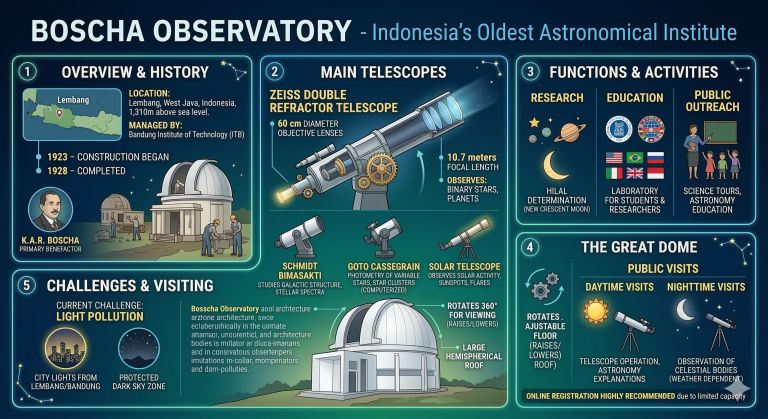
The Bosscha Observatory is the oldest astronomical research institution in Indonesia, located in Lembang, West Java. Situated at an altitude of approximately 1,310 meters above sea level, it is managed by the Bandung Institute of Technology (ITB) and serves as a primary center for astronomical research and education in Southeast Asia.
1. A Brief History
The observatory was established by the Nederlandsch-Indische Sterrenkundige Vereeniging (Netherlands-Indies Astronomical Association). Construction began in 1923 and was completed in 1928. It was named after Karel Albert Rudolf Bosscha, a wealthy tea plantation owner who served as the primary benefactor for the facility’s construction.
2. Main Telescopes
Bosscha Observatory houses several sophisticated telescopes used for various research purposes:
Zeiss Double Refractor Telescope: The most iconic telescope, housed within the large dome. It features two objective lenses with a diameter of 60 cm and a focal length of 10.7 meters. It is primarily used for observing binary stars and planets.
Schmidt Bimasakti Telescope: Used to study the structure of our galaxy, the Milky Way (Bimasakti), and to observe stellar spectra.
GOTO Cassegrain Telescope: The first computerized telescope at Bosscha, used for photometry (measuring light intensity) of variable stars and star clusters.
Solar Telescope: A specialized facility for observing solar activity, including sunspots and solar flares.
3. Functions and Activities
As a scientific institution, Bosscha fulfills three main functions:
Research: Observations of binary stars, exoplanets, comets, and the determination of the Hilal (the new crescent moon) for the establishment of the Islamic calendar in Indonesia.
Education: Serving as a laboratory for ITB Astronomy students as well as researchers from around the world.
Public Outreach: Educating the public through scientific tours to introduce astronomy to the general community.
4. Architecture and the Great Dome
A signature feature of Bosscha is the Zeiss Dome building. This structure has a hemispherical roof that can rotate 360 degrees. Despite weighing dozens of tons, the roof moves smoothly via electric motors. The floor inside the dome can also be raised or lowered to align the observer with the telescope’s eyepiece.
5. Current Challenge: Light Pollution
Currently, the Bosscha Observatory faces a significant threat from light pollution due to massive urban development in the Lembang and Bandung areas. Excessive city lights make it difficult for telescopes to capture the faint light of distant celestial objects. Consequently, the local government has designated the area as a cultural heritage site and a protected “dark sky zone.”
6. Public Visits
The observatory is open to the general public on a specific schedule:
Daytime Visits: Visitors can see how the Zeiss telescope operates and receive astronomical explanations.
Nighttime Visits: Offers visitors the chance to observe celestial bodies directly through portable telescopes (highly dependent on weather conditions).
Note: For those planning to visit, online registration via the official Bosscha website is highly recommended due to limited capacity.
Amir Maulana – SKYWORLD
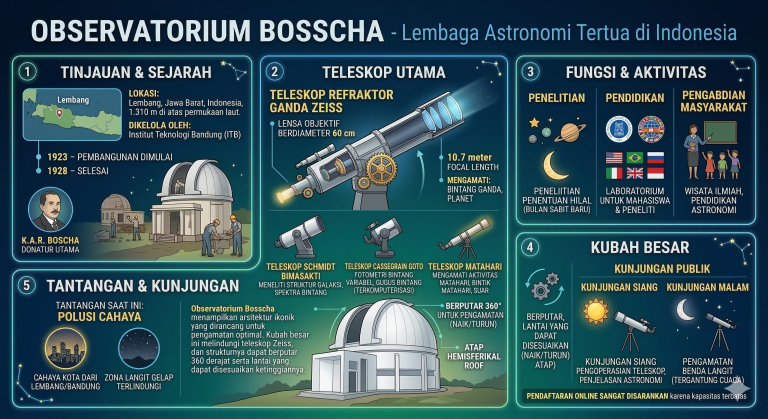
Observatorium Bosscha adalah lembaga riset astronomi tertua di Indonesia yang terletak di Lembang, Jawa Barat. Berada di ketinggian sekitar 1.310 meter di atas permukaan laut, observatorium ini dikelola oleh Institut Teknologi Bandung (ITB) dan menjadi pusat penelitian serta pendidikan astronomi utama di Asia Tenggara.
Berikut adalah informasi lengkap mengenai Observatorium Bosscha:
1. Sejarah Singkat
Observatorium ini didirikan oleh Nederlandsch-Indische Sterrenkundige Vereeniging (Perhimpunan Astronom Hindia Belanda). Pembangunannya dimulai pada tahun 1923 dan selesai pada tahun 1928. Nama “Bosscha” diambil dari Karel Albert Rudolf Bosscha, seorang tuan tanah perkebunan teh yang menjadi penyandang dana utama pembangunan fasilitas ini.
2. Instrumen Teleskop Utama
Observatorium Bosscha memiliki beberapa teleskop canggih yang digunakan untuk berbagai keperluan penelitian:
Teleskop Refraktor Ganda Zeiss: Teleskop paling ikonik yang berada di dalam kubah besar. Teleskop ini memiliki dua lensa objektif dengan diameter 60 cm dan panjang fokus 10,7 meter. Biasanya digunakan untuk mengamati bintang ganda dan planet.
Teleskop Schmidt Bimasakti: Digunakan untuk mempelajari struktur galaksi kita, Bima Sakti, serta pengamatan spektrum bintang.
Teleskop Cassegrain GOTO: Teleskop komputerisasi pertama di Bosscha yang digunakan untuk fotometri (mengukur intensitas cahaya) bintang variabel dan gugus bintang.
Teleskop Surya: Fasilitas khusus untuk mengamati aktivitas matahari, termasuk bintik matahari dan lidah api matahari.
3. Fungsi dan Kegiatan
Sebagai lembaga ilmiah, Bosscha menjalankan tiga fungsi utama:
Penelitian: Pengamatan bintang ganda, eksoplanet, komet, serta penentuan hilal (bulan sabit muda) untuk penetapan kalender Islam di Indonesia.
Pendidikan: Menjadi laboratorium bagi mahasiswa Astronomi ITB dan peneliti dari mancanegara.
Pengabdian Masyarakat: Edukasi publik melalui kunjungan wisata ilmiah untuk memperkenalkan astronomi kepada masyarakat luas.
4. Arsitektur dan Kubah
Salah satu ciri khas Bosscha adalah gedung Kubah Zeiss. Gedung ini memiliki atap berbentuk setengah bola yang dapat berputar 360 derajat. Berat atapnya mencapai puluhan ton, namun dapat digerakkan dengan halus menggunakan motor listrik. Bagian lantai di dalam kubah juga bisa naik-turun untuk menyesuaikan posisi pengamat dengan lensa teleskop.
5. Tantangan Saat Ini: Polusi Cahaya
Saat ini, Observatorium Bosscha menghadapi tantangan besar berupa polusi cahaya akibat pembangunan yang masif di kawasan Lembang dan Bandung. Cahaya lampu kota yang terlalu terang menyulitkan teleskop untuk menangkap cahaya redup dari benda-bintang jauh. Oleh karena itu, pemerintah setempat telah menetapkan kawasan ini sebagai kawasan cagar budaya dan zona gelap yang dilindungi.
6. Kunjungan Publik
Observatorium Bosscha menerima kunjungan masyarakat umum dengan jadwal tertentu:
Kunjungan Siang: Melihat cara kerja teleskop Zeiss dan mendapatkan penjelasan astronomi.
Kunjungan Malam: Memberikan kesempatan kepada pengunjung untuk melihat benda langit secara langsung melalui teleskop portabel (sangat bergantung pada kondisi cuaca).
Amir Maulana – SKYWORLD