
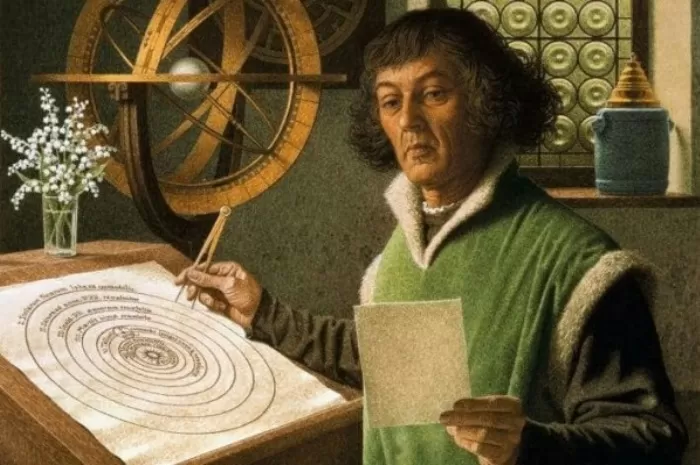
Credit ; https://www.porosjakarta.com/
Who was Nicolaus Copernicus?
Nicolaus Copernicus (February 19, 1473 – May 24, 1543) was a Renaissance-era Polish polymath, astronomer, mathematician, physician, and translator. He is best known worldwide for formulating the heliocentric theory, a model of the universe that placed the Sun—rather than the Earth—at the center of the solar system.
Early Life and Education
Birth: Copernicus was born in the city of Toruń, in the region of Royal Prussia, which was a part of the Kingdom of Poland. He came from a wealthy family of copper merchants.
Diverse Education: After his father died, he was raised by his uncle, a bishop who ensured Copernicus received the best education. He studied at the University of Kraków (now Jagiellonian University) in Poland, and then continued his studies in Italy (Bologna, Padua, and Ferrara).
Multidisciplinary: In Italy, he studied not only astronomy and mathematics but also canon law (church law) and medicine. This broad background gave him a strong analytical perspective.
Heliocentric Theory (Sun-Centered)
Before Copernicus, the dominant worldview for over 1,000 years was the geocentric (Ptolemaic) model, which believed that the Earth stood still at the center of the universe and all celestial bodies revolved around it.
Copernicus shattered this view with several key principles:
Sun at the Center: The Earth and other planets orbit the Sun in circular paths.
Earth’s Rotation: The daily movement of the Sun, Moon, and stars in the sky is actually caused by the Earth rotating on its axis every 24 hours.
Distance of the Stars: The stars are incredibly far away compared to the distance from the Earth to the Sun, which explains why they appear stationary.
Major Work: De revolutionibus orbium coelestium
Copernicus’s heliocentric ideas were detailed in his magnum opus titled De revolutionibus orbium coelestium (On the Revolutions of the Heavenly Spheres).
Delayed Publication: He delayed publishing this book for decades. This was partly because he was constantly trying to perfect his mathematical calculations, and partly because he feared backlash and rejection from both the academic and religious communities of the time.
Publication: The book was finally published just before his death in 1543. Legend has it that he only held the first printed copy of his book on his deathbed.
Legacy and Impact (The Copernican Revolution)
Copernicus’s ideas were not widely accepted immediately after his death. However, his theory sparked what we now call the Copernican Revolution.
He paved the way for future astronomers like Johannes Kepler (who proved that planetary orbits are elliptical, not perfectly circular) and Galileo Galilei (who used a telescope to gather physical evidence for the heliocentric theory).
Philosophically, this theory changed humanity’s place in the universe, showing that the Earth is just an ordinary planet, not the center of everything.
Amir Maulana – SKYWORLD
Berikut adalah informasi lengkap mengenai Nicolaus Copernicus, salah satu tokoh paling berpengaruh dalam sejarah ilmu pengetahuan.
Siapa Nicolaus Copernicus?
Nicolaus Copernicus (19 Februari 1473 – 24 Mei 1543) adalah seorang polimatik, astronom, matematikawan, dokter, dan penerjemah asal Polandia yang hidup pada masa Renaisans. Ia paling dikenal dunia karena merumuskan teori heliosentris, sebuah model alam semesta yang menempatkan Matahari—bukan Bumi—sebagai pusat tata surya.
Kehidupan Awal dan Pendidikan
Kelahiran: Copernicus lahir di kota Toruń, di wilayah Royal Prussia, yang merupakan bagian dari Kerajaan Polandia. Ia berasal dari keluarga pedagang tembaga yang kaya.
Pendidikan Beragam: Setelah ayahnya meninggal, ia diasuh oleh pamannya, seorang uskup yang memastikan Copernicus mendapat pendidikan terbaik. Ia belajar di Universitas Kraków (sekarang Universitas Jagiellonian) di Polandia, lalu melanjutkan studi ke Italia (Bologna, Padua, dan Ferrara).
Multidisiplin: Di Italia, ia tidak hanya belajar astronomi dan matematika, tetapi juga hukum gereja (hukum kanon) dan kedokteran. Latar belakang yang luas ini membuatnya memiliki perspektif analitis yang kuat.
Teori Heliosentris (Pusat Matahari)
Sebelum Copernicus, pandangan yang mendominasi dunia selama lebih dari 1.000 tahun adalah model geosentris (Ptolemaik), yang meyakini bahwa Bumi diam di pusat alam semesta dan semua benda langit mengelilinginya.
Copernicus mematahkan pandangan ini dengan beberapa prinsip utama:
Matahari di Pusat: Bumi dan planet-planet lain mengorbit Matahari dalam lintasan melingkar.
Rotasi Bumi: Gerakan harian Matahari, Bulan, dan bintang-bintang di langit sebenarnya disebabkan oleh Bumi yang berputar pada porosnya setiap 24 jam.
Jarak Bintang: Bintang-bintang berada sangat jauh dibandingkan dengan jarak Bumi ke Matahari, yang menjelaskan mengapa mereka tampak diam.
Karya Utama: De revolutionibus orbium coelestium
Gagasan heliosentris Copernicus dituangkan dalam buku agungnya yang berjudul De revolutionibus orbium coelestium (Tentang Putaran Bola-bola Langit).
Penundaan Publikasi: Ia menunda penerbitan buku ini selama puluhan tahun. Hal ini sebagian karena ia terus berusaha menyempurnakan perhitungan matematisnya, dan sebagian lagi karena khawatir akan reaksi penolakan dari kalangan akademisi maupun gereja pada saat itu.
Penerbitan: Buku tersebut akhirnya diterbitkan tepat sebelum kematiannya pada tahun 1543. Konon, ia baru memegang salinan cetak pertama dari bukunya tersebut di ranjang kematiannya.
Warisan dan Dampak (Revolusi Kopernikan)
Gagasan Copernicus tidak langsung diterima secara luas saat ia meninggal. Namun, teorinya memicu apa yang sekarang kita sebut sebagai Revolusi Kopernikan.
Ia membuka jalan bagi astronom masa depan seperti Johannes Kepler (yang membuktikan bahwa orbit planet berbentuk elips, bukan lingkaran sempurna) dan Galileo Galilei (yang menggunakan teleskop untuk mengumpulkan bukti fisik teori heliosentris).
Secara filosofis, teori ini mengubah posisi manusia di alam semesta, menunjukkan bahwa Bumi hanyalah salah satu planet biasa, bukan pusat dari segala sesuatu.
Amir Maulana – SKYWORLD