
The phenomenon of “falling stars” or meteors is one of the most stunning natural displays in the night sky. Although often called stars, scientifically, meteors are not stars at all.
Here is a complete guide to meteors, covering their origins, characteristics, and different types.
1. Key Distinctions: Meteoroid, Meteor, and Meteorite
People often use these terms interchangeably, but the difference lies in the location of the object:
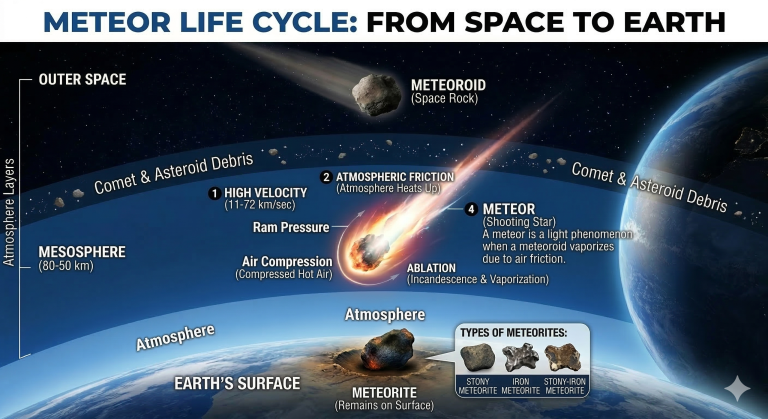
Meteoroid: Rocks or debris in space (still outside Earth’s atmosphere). They range in size from a grain of sand to large boulders.
Meteor: The streak of light seen when a meteoroid enters Earth’s atmosphere at high speed and burns up due to friction. This is what we call a “falling star.”
Meteorite: The remains of a meteor that do not completely burn up in the atmosphere and manage to reach and strike the Earth’s surface.
2. How are Meteors Formed?
A meteor occurs because of friction between a meteoroid and air molecules in the atmosphere (usually in the Mesosphere layer).
High Velocity: Meteoroids enter Earth’s atmosphere at incredible speeds, ranging from 11 km/s to 72 km/s.
Ram Pressure: As it hits the air at that speed, the air in front of the meteoroid is compressed very quickly, causing the temperature to rise drastically (reaching thousands of degrees Celsius).
Ablation: This intense heat causes the rock to vaporize and glow, creating the tail of light we see from the ground.
3. Types of Meteors Based on Appearance
Not all meteors look the same. Some have very specific characteristics:
| Type | Description |
| Earthgrazer | A meteor that enters the atmosphere at a very shallow angle, then “bounces” back into space or streaks across the sky for a long time. |
| Fireball | An exceptionally bright meteor, often brighter than the planet Venus. |
| Bolide | A fireball that explodes in the atmosphere, often accompanied by a sonic boom. |
4. Meteor Showers
A meteor shower occurs when Earth passes through the orbital path of a comet or asteroid that has left behind a trail of dust and debris. When this debris enters the atmosphere en masse, a shower occurs.
Some famous annual meteor showers include:
Perseids: Occurs around August (originated from comet Swift-Tuttle).
Geminids: Occurs around December (originated from asteroid 3200 Phaethon).
Leonids: Occurs around November (famous for massive meteor storms every 33 years).
5. Composition of Meteorites (Remains)
If a meteor successfully lands on Earth, scientists typically classify it into three main categories:
Stony Meteorites: The most common type (about 94%), composed of silicates.
Iron Meteorites: Made of frozen liquid nickel and iron. They are very heavy and dense.
Stony-Iron Meteorites: A rare mixture of silicate crystals and iron metal.
Interesting Fact: Did you know that every day, Earth is “showered” with approximately 48.5 tons of meteoric material? However, most of it consists of harmless microscopic dust.
Amir Maulana – SKYWORLD
Fenomena “bintang jatuh” atau meteor adalah salah satu pertunjukan alam paling memukau di langit malam. Meskipun sering disebut bintang, secara ilmiah meteor sama sekali bukan bintang.
Berikut adalah informasi lengkap mengenai meteor, mulai dari asal-usul hingga jenis-jenisnya.
1. Perbedaan Penting: Meteoroid, Meteor, dan Meteorit
Seringkali orang tertukar dalam menggunakan istilah ini. Perbedaannya terletak pada lokasi benda tersebut berada:
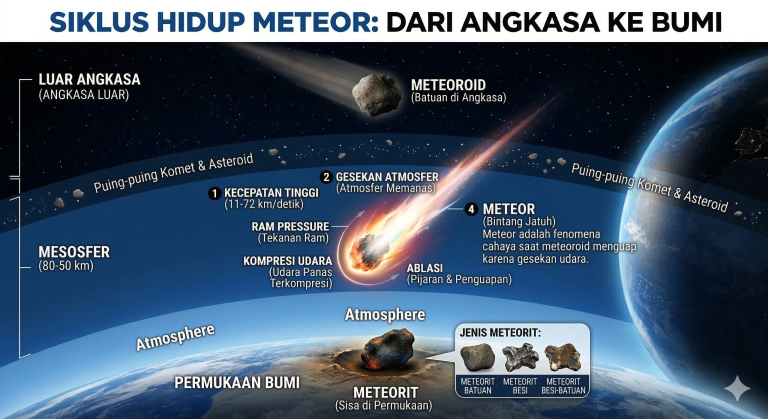
Meteoroid: Batuan atau puing-puing di luar angkasa (masih di luar atmosfer Bumi). Ukurannya bervariasi, dari sebutir pasir hingga batu besar.
Meteor: Garis cahaya yang terlihat saat meteoroid masuk ke atmosfer Bumi dengan kecepatan tinggi dan terbakar karena gesekan udara. Inilah yang kita sebut “bintang jatuh”.
Meteorit: Sisa-sisa meteor yang tidak habis terbakar di atmosfer dan berhasil mencapai serta menghantam permukaan Bumi.
2. Bagaimana Meteor Terbentuk?
Meteor terjadi karena adanya gesekan antara meteoroid dengan molekul udara di lapisan atmosfer (biasanya di lapisan Mesosfer).
Kecepatan Tinggi: Meteoroid memasuki atmosfer Bumi dengan kecepatan luar biasa, berkisar antara 11 km/detik hingga 72 km/detik.
Ram Pressure: Saat menabrak udara dengan kecepatan itu, udara di depan meteoroid terkompresi dengan sangat cepat, suhunya naik drastis (bisa mencapai ribuan derajat Celsius).
Ablasi: Suhu panas ini menyebabkan batuan tersebut menguap dan berpijar, menciptakan ekor cahaya yang kita lihat dari permukaan Bumi.
3. Jenis-Jenis Meteor Berdasarkan Penampakan
Tidak semua meteor terlihat sama. Beberapa memiliki karakteristik khusus:
| Jenis | Deskripsi |
| Earthgrazer | Meteor yang masuk ke atmosfer dengan sudut sangat landai, lalu “membalul” kembali ke luar angkasa atau melintasi langit dalam waktu lama. |
| Fireball (Bola Api) | Meteor yang sangat terang, bahkan bisa lebih terang dari planet Venus. |
| Bolide | Fireball yang meledak di atmosfer, seringkali disertai dentuman sonik (sonic boom). |
4. Hujan Meteor (Meteor Shower)
Hujan meteor terjadi ketika Bumi melewati jalur orbit sebuah komet atau asteroid yang meninggalkan jejak debu dan puing. Saat puing-puing ini masuk ke atmosfer secara massal, terjadilah hujan meteor.
Beberapa hujan meteor tahunan yang terkenal:
Perseid: Terjadi sekitar bulan Agustus (berasal dari komet Swift-Tuttle).
Geminid: Terjadi sekitar bulan Desember (berasal dari asteroid 3200 Phaethon).
Leonid: Terjadi sekitar bulan November (terkenal dengan badai meteor besar setiap 33 tahun sekali).
5. Komposisi Meteorit (Sisa Meteor)
Jika sebuah meteor berhasil mendarat di Bumi, para ilmuwan biasanya mengklasifikasikannya menjadi tiga jenis utama:
Meteorit Batuan (Stony): Jenis paling umum (sekitar 94%), terdiri dari silikat.
Meteorit Besi (Iron): Terdiri dari nikel dan besi cair yang membeku. Sangat berat dan padat.
Meteorit Besi-Batuan (Stony-Iron): Campuran langka antara kristal silikat dan logam besi.
Catatan Menarik: Tahukah Anda bahwa setiap harinya, Bumi “dihujani” oleh sekitar 48,5 ton material meteoritik? Namun, sebagian besar berupa debu mikroskopis yang tidak berbahaya.
Amir Maulana – SKYWORLD