
A solar eclipse is one of the most mesmerizing astronomical phenomena, where the Moon passes between the Earth and the Sun, obscuring some or all of the Sun’s light from our perspective.
Here is a complete guide to this phenomenon:
1. How Does a Solar Eclipse Occur?
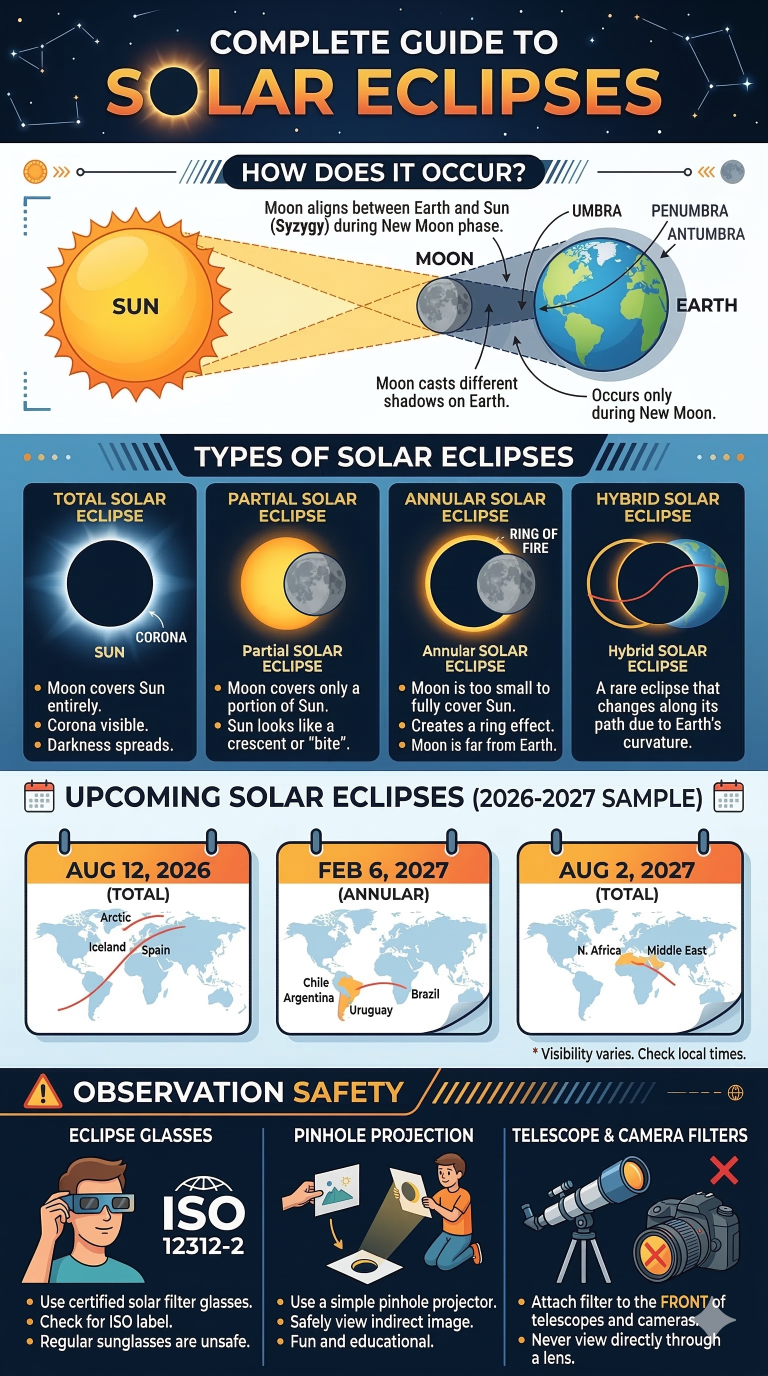
A solar eclipse happens during the New Moon phase, when the Sun, Moon, and Earth align in a straight line (a phenomenon known as Syzygy). Because the Moon’s orbit is slightly tilted (about 5°) relative to Earth’s orbit around the Sun, an eclipse does not happen every month.
During this process, the Moon casts different types of shadows onto Earth:
Umbra: The darkest, central part of the shadow. Observers in this area see a total eclipse.
Penumbra: The outer, lighter part of the shadow. Observers here see only a partial eclipse.
Antumbra: The shadow area beyond the tip of the umbral cone, where an annular eclipse occurs.
2. Types of Solar Eclipses
Not all eclipses look the same. Their appearance depends on the Moon’s distance from Earth in its elliptical orbit.
Total Solar Eclipse: The Moon completely covers the Sun’s disk. For a few minutes, the sky turns dark like night, and the corona (the Sun’s outer atmosphere) becomes visible.
Partial Solar Eclipse: The Moon covers only a portion of the Sun, making it look like a crescent or as if a “bite” has been taken out of it.
Annular Solar Eclipse: Occurs when the Moon is at its farthest point from Earth (apogee). Because it appears smaller, it doesn’t cover the entire Sun, leaving a bright ring of light known as the “ring of fire.”
Hybrid Solar Eclipse: A rare event where the eclipse shifts between annular and total along its path due to the curvature of the Earth’s surface.
3. Upcoming Solar Eclipse Schedule (2026–2027)
Based on current astronomical data for this year and next:
| Date | Type | Primary Observation Locations |
| August 12, 2026 | Total | Arctic, Greenland, Iceland, Spain, Portugal. |
| February 6, 2027 | Annular | Chile, Argentina, Uruguay, Brazil, West Africa. |
| August 2, 2027 | Total | Southern Spain, North Africa, Middle East. |
Note for Indonesia: Unfortunately, the total eclipse in August 2026 will not be visible from the Indonesian region. However, you can still watch it through live astronomical broadcasts online.
4. How to Observe Safely
Never look directly at the Sun without proper protection, even during a partial eclipse. Infrared and ultraviolet radiation can cause permanent retinal damage (solar retinopathy).
Use Eclipse Glasses: Ensure they are ISO 12312-2 certified. Regular sunglasses are not nearly dark enough to protect your eyes.
Pinhole Projection: If you don’t have glasses, use a pinhole projector by poking a small hole in a piece of cardstock and projecting the Sun’s image onto a flat surface.
Telescope/Camera Filters: If using optical equipment, solar filters must be attached to the front of the lens (the objective) to prevent concentrated heat from damaging the equipment or your eyes.
Beyond the visual spectacle, solar eclipses often trigger unusual animal behavior, such as birds suddenly going silent as they mistake the midday darkness for dusk.
Amir Maulana – SKYWORLD
Gerhana matahari adalah salah satu fenomena astronomi yang paling memukau, di mana Bulan melintas di antara Bumi dan Matahari, sehingga menutupi sebagian atau seluruh cahaya Matahari dari pandangan kita.
Berikut adalah panduan lengkap mengenai fenomena ini:
1. Bagaimana Gerhana Matahari Terjadi?
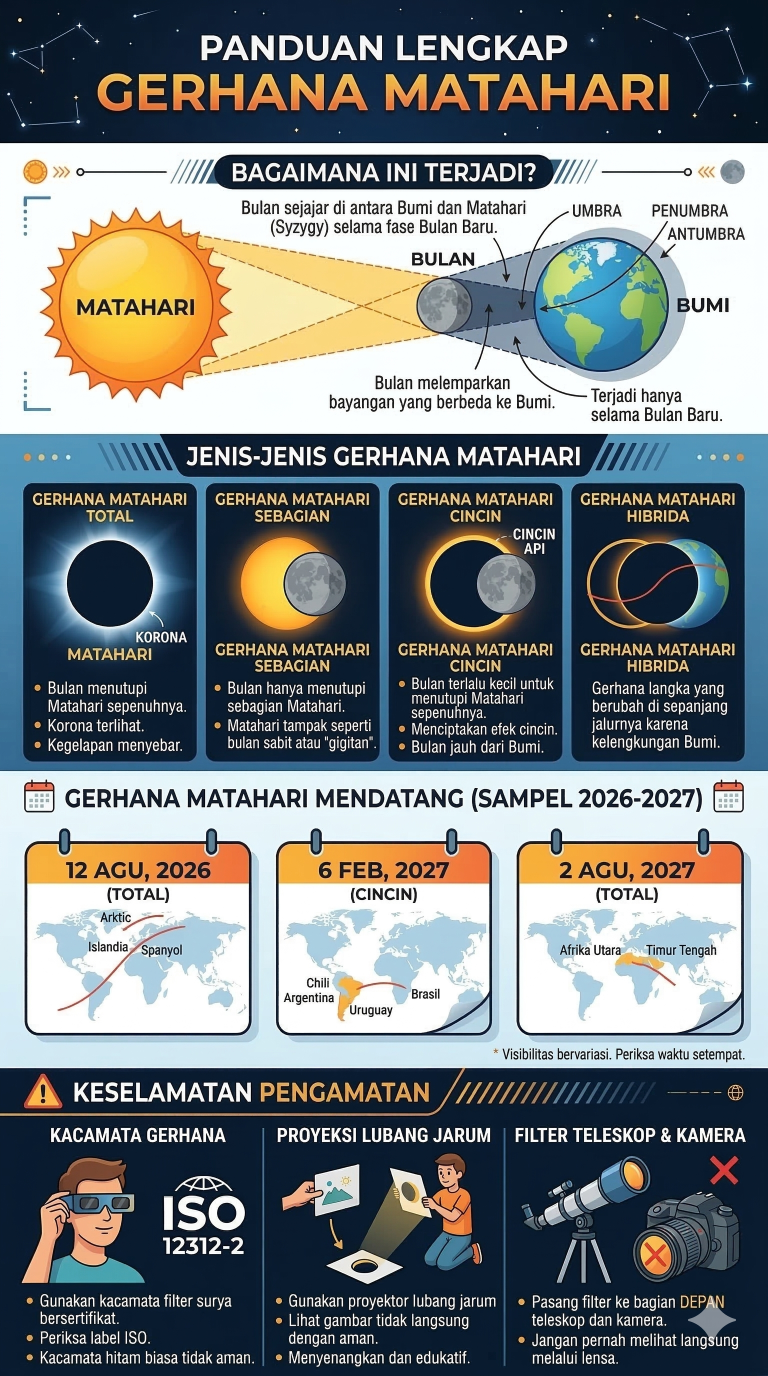
Gerhana matahari terjadi dalam fase Bulan Baru, ketika Matahari, Bulan, dan Bumi berada pada satu garis lurus yang sejajar (fenomena ini disebut Syzygy). Karena orbit Bulan sedikit miring (sekitar 5°) terhadap orbit Bumi mengelilingi Matahari, gerhana tidak terjadi setiap bulan.
Dalam proses ini, Bulan menghasilkan dua jenis bayangan yang jatuh ke Bumi:
Umbra: Bagian inti bayangan yang paling gelap. Di area ini, pengamat akan melihat gerhana total.
Penumbra: Bayangan kabur di sekitar umbra. Di area ini, pengamat hanya melihat gerhana sebagian.
Antumbra: Area bayangan yang terbentuk di luar ujung kerucut umbra, tempat terjadinya gerhana cincin.
2. Jenis-Jenis Gerhana Matahari
Tidak semua gerhana terlihat sama. Bentuknya bergantung pada seberapa jauh Bulan dari Bumi dalam orbit elipsnya.
Gerhana Matahari Total: Bulan menutupi seluruh piringan Matahari. Selama beberapa menit, langit menjadi gelap seperti malam, dan kita bisa melihat korona (atmosfer luar Matahari).
Gerhana Matahari Sebagian: Bulan hanya menutupi sebagian piringan Matahari, sehingga Matahari tampak seperti “digigit” atau berbentuk sabit.
Gerhana Matahari Cincin (Annular): Terjadi saat Bulan berada di titik terjauh dari Bumi (apogee). Karena tampak lebih kecil, Bulan tidak menutupi seluruh Matahari, sehingga menyisakan tepi cahaya yang menyerupai cincin api.
Gerhana Matahari Hibrida: Jenis langka di mana gerhana berubah dari cincin menjadi total (atau sebaliknya) di sepanjang jalur gerhana karena kelengkungan permukaan Bumi.
3. Jadwal Gerhana Matahari Mendatang (2026–2027)
Berdasarkan data astronomi terbaru untuk tahun ini dan tahun depan:
| Tanggal | Jenis Gerhana | Lokasi Pengamatan Utama |
| 12 Agustus 2026 | Total | Arktik, Greenland, Islandia, Spanyol, Portugal. |
| 6 Februari 2027 | Cincin | Chili, Argentina, Uruguay, Brasil, Afrika Barat. |
| 2 Agustus 2027 | Total | Spanyol Selatan, Afrika Utara, Timur Tengah. |
Catatan untuk Indonesia: Sayangnya, gerhana total pada Agustus 2026 tidak akan terlihat dari wilayah Indonesia. Namun, Anda masih bisa menyaksikannya melalui siaran langsung astronomi secara daring.
4. Cara Mengamati dengan Aman
Jangan pernah melihat langsung ke Matahari tanpa perlindungan yang tepat, bahkan saat gerhana sebagian, karena radiasi inframerah dan ultraviolet dapat merusak retina secara permanen (retinopati surya).
Gunakan Kacamata Gerhana: Pastikan memiliki sertifikasi internasional ISO 12312-2. Kacamata hitam biasa tidak cukup kuat untuk melindungi mata.
Metode Proyeksi: Jika tidak punya kacamata, gunakan proyektor lubang jarum (pinhole projector) dengan melubangi kertas karton dan membiarkan bayangan Matahari jatuh ke permukaan datar.
Filter Teleskop/Kamera: Jika menggunakan alat optik, filter surya harus dipasang di bagian depan lensa (bukan di depan mata) untuk mencegah panas terkonsentrasi yang bisa melelehkan alat atau merusak mata.
Fenomena ini tidak hanya indah tetapi juga sering mengubah perilaku hewan secara tiba-tiba, seperti burung yang berhenti berkicau karena mengira malam telah tiba.
Amir Maulana – SKYWORLD