
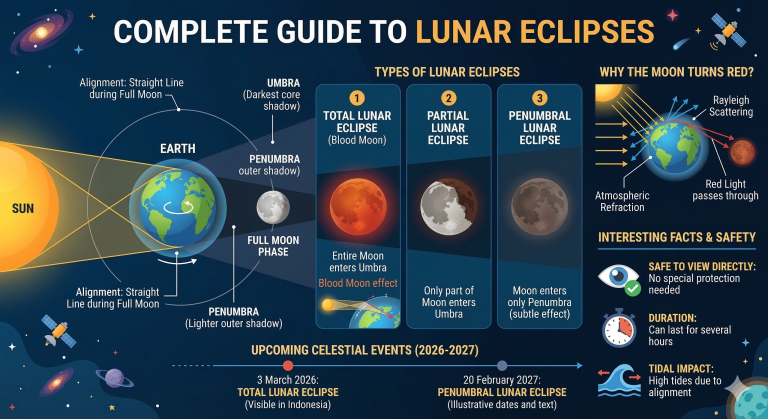
A lunar eclipse is a natural phenomenon that occurs when the Sun, Earth, and Moon are aligned in a straight line, causing the Moon to pass into the Earth’s shadow. This event only happens during a Full Moon.
Here are the complete details regarding lunar eclipses:
1. How Does the Process Happen?
The Earth blocks the sunlight that would normally reflect off the Moon. The Earth’s shadow is divided into two main parts:
Umbra: The darkest, central part of the shadow (the core).
Penumbra: The lighter, outer part of the shadow where the light is only partially blocked.
2. Types of Lunar Eclipses
Based on the Moon’s position within the Earth’s shadow, eclipses are categorized into three types:
| Type of Eclipse | Visual Description | Cause |
| Total | The Moon appears dark red (Blood Moon). | The entire Moon enters the Earth’s Umbra. |
| Partial | The Moon looks like a “bite” has been taken out of it. | Only a portion of the Moon enters the Umbra. |
| Penumbral | The Moon remains whole but looks dimmer or “smudgy.” | The Moon passes only through the Penumbra (faint shadow). |
3. Why Does the Moon Turn Red During a Total Eclipse?
This phenomenon happens because the Earth’s atmosphere refracts (bends) sunlight. Shorter wavelengths (blue light) are scattered away, while longer wavelengths (red light) are bent toward the Moon’s surface. The cleaner the Earth’s atmosphere is from pollution and dust, the brighter the red color will appear.
4. Eclipse Schedule for 2026 – 2027
2026 is an exciting year for skywatchers, particularly in Indonesia and the surrounding regions.
March 3, 2026 (Total Lunar Eclipse): This event recently occurred and was clearly visible across Indonesia. The totality phase lasted from approximately 18:03 to 19:03 WIB.
August 28, 2026 (Partial Lunar Eclipse): Unfortunately, this phenomenon will not be visible from Indonesia (it will be visible in the Americas, Europe, and Africa).
February 20, 2027 (Penumbral Lunar Eclipse): The entire Moon will pass through the penumbra, creating a subtle shading.
5. Interesting Facts & Safety
Safe to View Directly: Unlike a solar eclipse, a lunar eclipse is 100% safe to watch with the naked eye without any special protective equipment.
Duration: A lunar eclipse can last for several hours, with the totality phase potentially reaching up to 1 hour and 47 minutes.
Tidal Impact: Lunar eclipses affect the tides, often causing higher-than-usual high tides due to the alignment of gravitational forces.
Amir Maulana – SKYWORLD
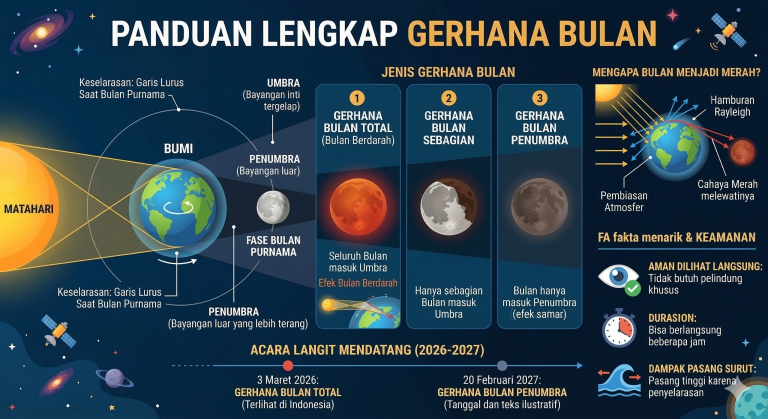
Gerhana bulan adalah fenomena alam yang terjadi saat posisi Matahari, Bumi, dan Bulan berada pada satu garis lurus, sehingga Bulan masuk ke dalam bayangan Bumi. Peristiwa ini hanya terjadi pada saat Bulan Purnama.
Berikut adalah rincian lengkap mengenai gerhana bulan:
1. Bagaimana Proses Terjadinya?
Bumi menghalangi cahaya Matahari yang seharusnya memantul ke Bulan. Bayangan Bumi terbagi menjadi dua bagian utama:
Umbra: Bagian bayangan yang paling gelap (inti).
Penumbra: Bagian bayangan luar yang lebih terang dan kabur.
2. Jenis-Jenis Gerhana Bulan
Berdasarkan posisi Bulan dalam bayangan Bumi, gerhana dibagi menjadi tiga:
| Jenis Gerhana | Deskripsi Visual | Penyebab |
| Total | Bulan tampak berwarna merah gelap (Blood Moon). | Seluruh bagian Bulan masuk ke bayangan Umbra Bumi. |
| Sebagian (Parsial) | Bulan terlihat seperti “tergigit” atau terpotong. | Hanya sebagian Bulan yang masuk ke bayangan Umbra. |
| Penumbra | Bulan tetap terlihat utuh namun warnanya lebih suram/redup. | Bulan hanya masuk ke bayangan Penumbra (bayangan kabur). |
3. Mengapa Bulan Berwarna Merah Saat Gerhana Total?
Fenomena ini terjadi karena atmosfer Bumi membiaskan cahaya Matahari. Cahaya dengan spektrum biru akan tersebar, sedangkan spektrum cahaya merah akan dibelokkan menuju permukaan Bulan. Semakin bersih atmosfer Bumi dari polusi dan debu, warna merahnya akan tampak semakin terang.
4. Jadwal Gerhana Tahun 2026 – 2027
Tahun 2026 adalah tahun yang menarik bagi pengamat langit, terutama di Indonesia.
3 Maret 2026 (Gerhana Bulan Total): Bisa diamati dengan jelas dari seluruh wilayah Indonesia. Fase totalitas terjadi sekitar pukul 18.03 – 19.03 WIB.
28 Agustus 2026 (Gerhana Bulan Sebagian): Sayangnya, fenomena ini tidak dapat diamati dari wilayah Indonesia (lebih terlihat di Amerika, Eropa, dan Afrika).
20 Februari 2027 (Gerhana Bulan Penumbra): Seluruh bagian Bulan masuk ke penumbra.
5. Fakta Menarik & Keamanan
Aman Dilihat Langsung: Berbeda dengan gerhana matahari, gerhana bulan 100% aman dilihat dengan mata telanjang tanpa alat pelindung khusus.
Durasi: Gerhana bulan bisa berlangsung selama beberapa jam, dengan fase totalitas maksimal bisa mencapai 1 jam 47 menit.
Dampak: Gerhana bulan memengaruhi pasang surut air laut, di mana pasang air laut biasanya menjadi lebih tinggi dari biasanya.
Amir Maulana – SKYWORLD