
Magelang – Jawa Tengah
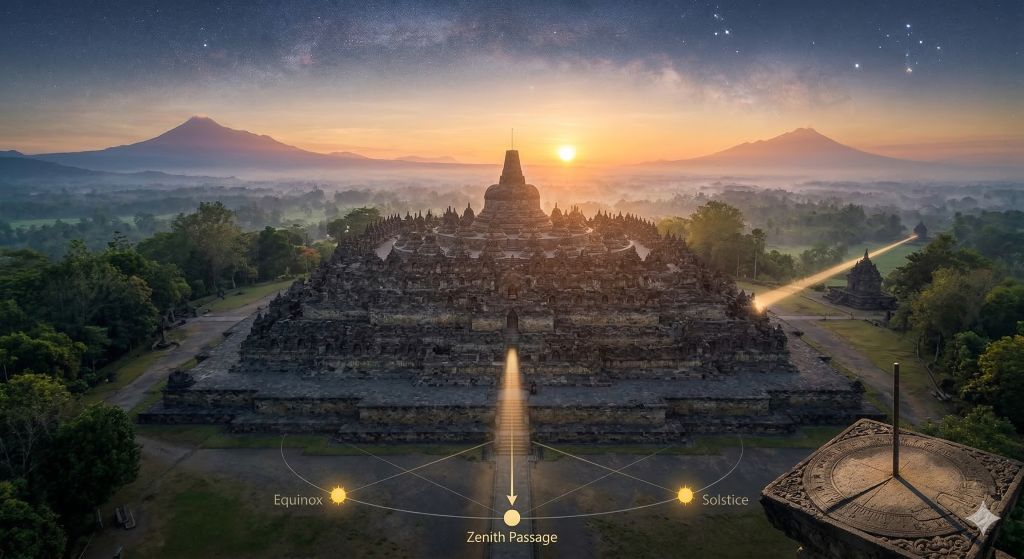
Borobudur Temple is not merely an architectural masterpiece and a spiritual center, but also a monument that reflects a highly advanced understanding of science and astronomy for its time.
Here is a comprehensive overview of the history of Borobudur Temple and its close connection to astronomy and solar mechanics.
A Brief History of Borobudur Temple
1. The Construction Period (8th to 9th Century AD) Borobudur Temple was built during the golden era of the Shailendra Dynasty, estimated between 750 and 850 AD. Constructed on a hill in Magelang, Central Java, the temple was designed as a holy site for Mahayana Buddhism as well as a representation of the universe (Buddhist cosmology). The legendary architect associated with its construction is known as Gunadharma.
The building features a step pyramid structure consisting of nine terraces (six square and three circular) crowned by a single main stupa. Symbolically, its structure is divided into three levels:
-
Kamadhatu: The base of the temple, representing the realm of human desires.
-
Rupadhatu: The carved galleries, representing the world of forms, where humans begin to leave their desires behind but are still bound to the physical world.
-
Arupadhatu: The top three circular terraces without reliefs, representing the formless realm, which is the highest level of spiritual attainment (Nirvana).
2. The Period of Abandonment Around the 14th century, Borobudur began to be abandoned. Several factors are believed to have triggered this, such as the devastating eruption of Mount Merapi that buried the temple under a thick layer of volcanic ash, as well as the shift of the royal center of power from Central to East Java. The temple was slowly buried under soil and engulfed by dense jungle for centuries.
3. Rediscovery and Restoration Borobudur was “rediscovered” in 1814 by the British Lieutenant-Governor, Sir Thomas Stamford Raffles, who received reports of a giant stone monument in the village of Bümisegara. He commissioned a Dutch engineer, H.C. Cornelius, to begin clearing the area.
Since then, Borobudur has undergone large-scale restorations:
-
First Restoration (1907-1911): Led by Theodoor van Erp from the Dutch East Indies government, focusing on repairing the main stupa and the three circular terraces at the top.
-
UNESCO Major Restoration (1973-1983): A massive structural rescue project involving the dismantling of over one million stones, the creation of a drainage system to prevent collapse, and the reconstruction of the temple’s foundation.
The Connection Between Borobudur Temple and Astronomy
More than just a pile of carved stones, Borobudur actually functioned like a giant observatory instrument. Archaeoastronomy experts have discovered that the construction of this temple relied heavily on calculations of celestial body movements.
1. Highly Precise Cardinal Direction Alignment The Borobudur structure is highly symmetrical and perfectly aligned with the four main cardinal directions (North, South, East, West). This precision was no coincidence, but rather the result of careful stellar observation to determine earthly coordinates long before the compass was invented. The main entrance of the temple faces due East to welcome the sunrise.
2. A Giant Sundial (Gnomon) Researchers believe that Borobudur was designed to record time like a sundial. The main central stupa at the peak of the temple acts as a gnomon (shadow-casting rod), while the 72 perforated stupas surrounding it act as markers. The movement of the shadows falling in this area throughout the year was used to measure time, track the changing of seasons, and determine the agricultural calendar (pranata mangsa).
3. Alignment of the Three Temples with the Sun’s Path (Zenith Passage) Geographically, Borobudur Temple, Pawon Temple, and Mendut Temple are situated on a single straight line. Scientists found that the straight line of these three temples aligns with the direction of the sunset during the solar culmination day (zenith passage), a phenomenon where the sun is directly overhead at noon so that shadows of upright objects disappear. The layout of these three temples was intentionally designed to mimic the path of the sun in the sky as a ritual procession route.
4. Capturing the Equinox Light Borobudur’s architecture was designed to capture celestial light during crucial moments of the earth’s rotation. The temple is oriented in such a way that it can perfectly capture the dawn sunlight during the equinox (the day when daytime and nighttime are exactly the same length globally). This morning light illuminates the temple structure straight and precisely, symbolizing the achievement of enlightenment that is in harmony with solar system mechanics.
5. Astronomical Numbers on the Stupas The placement of 72 perforated stupas at the Arupadhatu level is not merely for aesthetic value either. In various studies, this number is correlated with astronomical cycles, including symbolizing the number of days between the solstice and the zenith at Borobudur’s geographic latitude.
Borobudur Temple stands as tangible proof that our ancestors successfully merged a profound understanding of the universe, civil architecture, and spirituality into a masterpiece.
Candi Borobudur bukan hanya sekadar mahakarya arsitektur dan pusat spiritual, tetapi juga sebuah monumen yang menyimpan tingkat pemahaman sains dan astronomi yang sangat maju di zamannya.
Berikut adalah ulasan lengkap mengenai sejarah Candi Borobudur dan kaitan eratnya dengan ilmu perbintangan serta mekanika tata surya.
Sejarah Singkat Perjalanan Candi Borobudur
1. Masa Pembangunan (Abad ke-8 hingga ke-9 Masehi) Candi Borobudur dibangun pada masa kejayaan Wangsa Syailendra, diperkirakan antara tahun 750 hingga 850 Masehi. Dibangun di atas sebuah bukit di Magelang, Jawa Tengah, candi ini dirancang sebagai tempat suci agama Buddha Mahayana sekaligus representasi alam semesta (kosmologi Buddha). Arsitek legendaris yang dikaitkan dengan pembangunannya dikenal dengan nama Gunadharma.
Bangunan ini memiliki struktur punden berundak yang terdiri dari sembilan teras (enam bujur sangkar dan tiga melingkar) dan dimahkotai oleh satu stupa induk. Secara simbolis, strukturnya dibagi menjadi tiga tingkatan:
-
Kamadhatu: Bagian dasar candi yang melambangkan alam hawa nafsu manusia.
-
Rupadhatu: Bagian lorong berelief yang melambangkan dunia wujud, di mana manusia mulai meninggalkan hawa nafsu namun masih terikat dunia fisik.
-
Arupadhatu: Tiga teras bundar teratas tanpa relief yang melambangkan alam tak berwujud, tingkat pencapaian spiritual tertinggi (Nirwana).
2. Masa Penelantaran Sekitar abad ke-14, Borobudur mulai ditinggalkan. Ada beberapa faktor yang diyakini memicu hal ini, seperti letusan dahsyat Gunung Merapi yang mengubur candi di bawah lapisan abu vulkanik yang tebal, serta perpindahan pusat kekuasaan kerajaan dari Jawa Tengah ke Jawa Timur. Candi ini perlahan tertimbun tanah dan diselimuti hutan belantara selama berabad-abad.
3. Penemuan Kembali dan Restorasi Borobudur kembali “ditemukan” pada tahun 1814 oleh Gubernur Jenderal Inggris, Sir Thomas Stamford Raffles, yang mendapat laporan adanya monumen batu raksasa di desa Bümisegara. Ia mengutus insinyur asal Belanda, H.C. Cornelius, untuk mulai membersihkan area tersebut.
Sejak saat itu, Borobudur mengalami pemugaran berskala besar:
-
Pemugaran Pertama (1907-1911): Dipimpin oleh Theodoor van Erp dari pemerintah Hindia Belanda, difokuskan pada perbaikan stupa induk dan tiga teras melingkar di puncak.
-
Pemugaran Besar UNESCO (1973-1983): Proyek penyelamatan struktur besar-besaran yang melibatkan pembongkaran lebih dari satu juta batu, pembuatan sistem drainase untuk mencegah keruntuhan, dan penyusunan kembali fondasi candi.
Hubungan Candi Borobudur dengan Ilmu Astronomi
Lebih dari sekadar tumpukan batu berukir, Borobudur sebenarnya berfungsi layaknya sebuah instrumen observatorium raksasa. Para ahli arkeoastronomi menemukan bahwa pembangunan candi ini sangat bergantung pada perhitungan pergerakan benda langit.
1. Penyelarasan Mata Angin yang Sangat Presisi Bangunan Borobudur sangat simetris dan sejajar tepat dengan empat titik mata angin utama (Utara, Selatan, Timur, Barat). Presisi ini bukan kebetulan, melainkan hasil pengamatan bintang yang cermat untuk menentukan koordinat bumi jauh sebelum kompas diciptakan. Pintu masuk utama candi menghadap tepat ke arah Timur untuk menyambut terbitnya matahari.
2. Jam Matahari Raksasa (Gnomon) Peneliti meyakini bahwa Borobudur didesain untuk merekam waktu layaknya jam matahari. Stupa induk utama di puncak candi bertindak sebagai gnomon (batang penunjuk bayangan), sementara 72 stupa berlubang di sekelilingnya bertindak sebagai penanda. Pergerakan bayangan yang jatuh di area ini sepanjang tahun digunakan untuk mengukur waktu, membaca pergantian musim, dan menentukan kalender pertanian (pranata mangsa).
3. Penyelarasan Tiga Candi dengan Jalur Matahari (Zenith Passage) Secara geografis, Candi Borobudur, Candi Pawon, dan Candi Mendut terletak pada satu garis lurus. Para ilmuwan mendapati bahwa garis lurus ketiga candi ini selaras dengan arah matahari terbenam pada saat hari kulminasi matahari (zenith passage), yakni fenomena di mana matahari berada tepat di atas kepala pada siang hari sehingga bayangan benda tegak menghilang. Tata letak ketiga candi ini sengaja dirancang meniru jalur pergerakan matahari di langit sebagai lintasan prosesi ritual.
4. Menangkap Cahaya Ekuinoks Arsitektur Borobudur dirancang untuk menangkap cahaya langit pada momen-momen krusial perputaran bumi. Candi ini diorientasikan sedemikian rupa sehingga mampu menangkap sinar matahari fajar secara sempurna pada saat ekuinoks (hari di mana durasi siang dan malam sama persis di seluruh dunia). Cahaya pagi ini akan menyinari struktur candi secara lurus dan presisi, menyimbolkan pencapaian pencerahan atau enlightenment yang selaras dengan mekanika tata surya.
5. Angka Astronomis pada Stupa Penempatan 72 stupa berlubang di tingkat Arupadhatu juga bukan sekadar nilai estetika. Dalam berbagai kajian, angka ini dikorelasikan dengan siklus astronomis, termasuk melambangkan jumlah hari antara titik balik matahari (solstice) menuju titik kulminasi (zenith) di lintang geografis Borobudur.
Candi Borobudur menjadi bukti nyata bahwa leluhur kita telah berhasil meleburkan pemahaman mendalam tentang alam semesta, arsitektur sipil, dan spiritualitas menjadi sebuah mahakarya.