
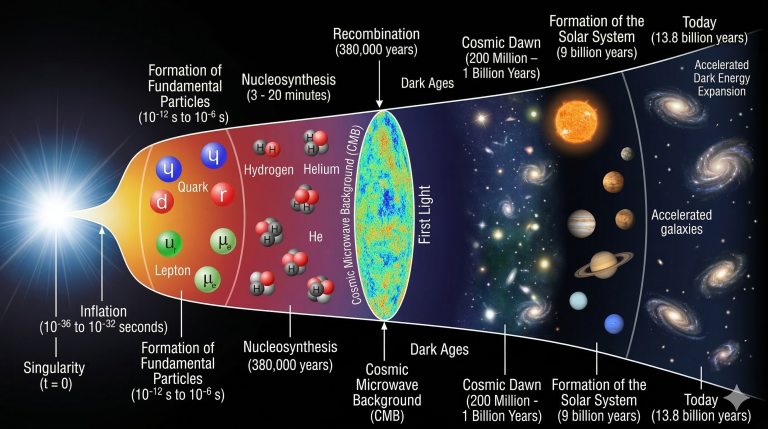
The Big Bang Theory is the best scientific explanation we have for how the universe began. Approximately 13.8 billion years ago, the universe started from a single point that was incredibly hot, dense, and tiny, known as a Singularity.
Here is the chronological timeline of the history of the universe based on this theory:
1. The Early Era (The First Seconds)
During this stage, the universe underwent extraordinary changes in an incredibly short amount of time.
Singularity ($t = 0$): The universe existed as a point of infinite density and heat. The laws of physics as we know them did not yet apply.
Inflation ($10^{-36}$ to $10^{-32}$ seconds): The universe underwent a super-fast expansion, growing from subatomic size to the size of a marble or larger in the blink of an eye.
Formation of Fundamental Particles ($10^{-12}$ seconds): Temperatures began to drop, allowing quarks, electrons, and neutrinos to form. However, it was still too hot for quarks to combine into protons or neutrons.
Formation of Protons and Neutrons ($10^{-6}$ seconds): Quarks began to combine to form protons and neutrons (hadrons).
2. The Nucleosynthesis Era (The First 3 Minutes)
Nucleosynthesis ($3$ to $20$ minutes): The temperature dropped low enough for protons and neutrons to fuse. This created the first atomic nuclei: Hydrogen and Helium, along with traces of Lithium. This is why our universe today is dominated by Hydrogen (~75%) and Helium (~25%).
3. The Recombination Era (380,000 Years)
Following nucleosynthesis, the universe was a hot “fog” of plasma so dense that light could not penetrate it (photons were constantly bumping into electrons).
Recombination: The universe cooled to approximately $3,000$ Kelvin. Electrons could finally settle into orbits around atomic nuclei, forming stable neutral atoms.
The First Light: Because electrons were now bound, photons (light) could finally travel freely through space. This light is still detectable today as the Cosmic Microwave Background (CMB) radiation.
4. The Dark Ages & Cosmic Dawn (200 Million – 1 Billion Years)
The Dark Ages: After the CMB was emitted, there were no new light sources. The universe consisted only of clouds of cold hydrogen and helium gas.
First Stars and Galaxies: Gravity began to pull denser clumps of gas together. Around 200 million years after the Big Bang, the first stars (Population III stars) began to ignite, ending the Dark Ages.
Reionization: Radiation from these first stars broke hydrogen atoms back down into protons and electrons.
5. The Modern Universe (9 Billion Years – Present)
Formation of the Solar System (9 billion years): Our Sun and its planetary system formed from a cloud of gas and dust left over from previous stellar explosions (supernovae).
Today (13.8 billion years): The universe continues to expand, and its rate of expansion is actually accelerating due to the influence of Dark Energy.
Teori Big Bang adalah penjelasan ilmiah terbaik yang kita miliki tentang bagaimana alam semesta bermula. Sekitar 13,8 miliar tahun yang lalu, alam semesta bermula dari satu titik yang sangat panas, sangat padat, dan sangat kecil yang disebut Singularitas.
Berikut adalah urutan kronologis sejarah alam semesta berdasarkan teori tersebut:
1. Era Awal (Detik-Detik Pertama)
Pada tahap ini, alam semesta mengalami perubahan yang luar biasa dalam waktu yang sangat singkat.
Singularitas ($t = 0$): Alam semesta berada pada titik dengan kepadatan dan panas yang tak terhingga. Hukum fisika yang kita kenal sekarang belum berlaku.
Inflasi ($10^{-36}$ hingga $10^{-32}$ detik): Alam semesta mengalami ekspansi yang sangat cepat (super-cepat), tumbuh dari ukuran subatomik menjadi seukuran bola kelereng atau lebih besar dalam sekejap mata.
Pembentukan Partikel Dasar ($10^{-12}$ detik): Suhu mulai turun sehingga kuark, elektron, dan neutrino dapat terbentuk. Namun, kondisi masih terlalu panas bagi kuark untuk bergabung membentuk proton atau neutron.
Pembentukan Proton dan Neutron ($10^{-6}$ detik): Kuark mulai bergabung membentuk proton dan neutron (hadron).
2. Era Nukleosintesis (3 Menit Pertama)
Nukleosintesis ($3$ – $20$ menit): Suhu turun cukup rendah sehingga proton dan neutron dapat berfusi. Hal ini menciptakan inti atom pertama, yaitu Hidrogen dan Helium, serta sedikit Litium. Inilah alasan mengapa alam semesta kita saat ini didominasi oleh Hidrogen (~75%) dan Helium (~25%).
3. Era Rekombinasi (380.000 Tahun)
Setelah nukleosintesis, alam semesta adalah “kabut” panas dari plasma yang sangat padat sehingga cahaya tidak bisa menembusnya (foton terus menabrak elektron).
Rekombinasi: Alam semesta mendingin hingga sekitar $3.000$ Kelvin. Elektron akhirnya bisa menetap di orbit sekitar inti atom, membentuk atom netral yang stabil.
Cahaya Pertama: Karena elektron sudah terikat, foton (cahaya) akhirnya bisa bergerak bebas melintasi ruang angkasa. Cahaya ini masih bisa kita deteksi hari ini sebagai Cosmic Microwave Background (CMB) atau radiasi latar belakang kosmik.
4. Zaman Kegelapan & Fajar Kosmik (200 Juta – 1 Miliar Tahun)
Dark Ages (Zaman Kegelapan): Setelah CMB terpancar, tidak ada sumber cahaya baru di alam semesta. Alam semesta hanya berisi awan gas hidrogen dan helium yang dingin.
Bintang dan Galaksi Pertama: Gravitasi mulai menarik gumpalan gas yang lebih padat. Sekitar 200 juta tahun setelah Big Bang, bintang pertama (Bintang Populasi III) mulai menyala. Cahaya dari bintang-bintang ini mengakhiri Zaman Kegelapan.
Reionisasi: Radiasi dari bintang-bintang pertama ini memecah kembali atom hidrogen menjadi proton dan elektron.
5. Alam Semesta Modern (9 Miliar Tahun – Sekarang)
Pembentukan Tata Surya (9 miliar tahun): Matahari kita dan sistem planetnya terbentuk dari awan gas dan debu sisa ledakan bintang-bintang sebelumnya (supernova).
Hari Ini (13,8 miliar tahun): Alam semesta terus mengembang, dan bahkan kecepatannya semakin meningkat karena pengaruh Energi Gelap (Dark Energy).