
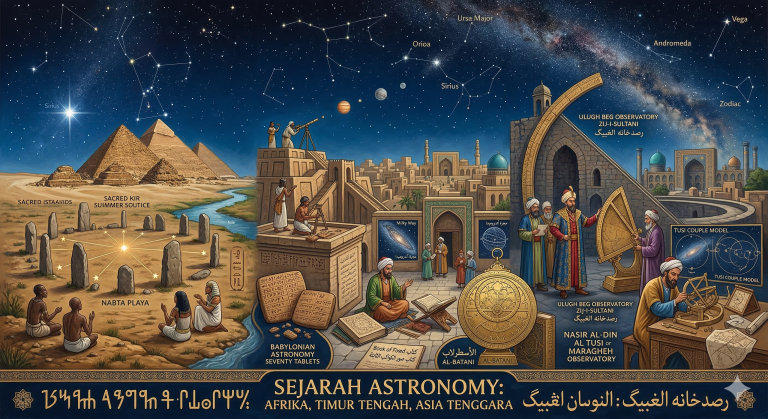
The history and development of astronomy in Africa, the Middle East, and Central Asia represent some of the most sophisticated intellectual achievements of the ancient and medieval worlds.
Here is the translation of the history and development of Ancient Astronomy in those regions:
1. Africa: Foundations in the Nile Valley and the Sahara
Africa is home to some of the world’s oldest archaeoastronomical sites, proving that indigenous populations were mapping the stars thousands of years ago.
Nabta Playa (Egypt/Sudan): Located in the Sahara Desert, this site contains a stone circle (similar to Stonehenge) dating back approximately 7,000 years. These stones align with the summer solstice, marking the onset of the monsoon season.
Ancient Egypt: The Egyptians developed a 365-day calendar based on the heliacal rising of the star Sirius (Sothis), which coincided with the annual flooding of the Nile. They also used stellar alignment to build the Pyramies of Giza with near-perfect North-South precision.
Dogon Astronomy (Mali): The Dogon people of Mali possess controversial yet profound oral knowledge regarding the Sirius star system, including details about Sirius B (a white dwarf invisible to the naked eye), though the origins of this knowledge remain a subject of historical debate.
2. The Middle East: From Mesopotamia to the Islamic Golden Age
This region served as the primary “kitchen” for the development of the mathematics that supports modern astronomy.
Mesopotamia (Sumeria & Babylonia)
The Babylonians were incredibly diligent sky watchers. They recorded eclipses and planetary positions on clay tablets.
They introduced the sexagesimal system (base-60) which we still use today to measure time (60 seconds, 60 minutes) and the degrees of a circle ($360^\circ$).
The Islamic Golden Age (8th – 15th Century)
While Europe was in the Middle Ages, astronomy flourished in Baghdad, Cairo, and Damascus.
Al-Battani: Calculated the length of the solar year with high accuracy (365 days, 5 hours, 46 minutes, and 24 seconds).
Al-Sufi: Wrote the Book of Fixed Stars, where he first recorded the Andromeda Galaxy and the Large Magellanic Cloud.
Instruments: Muslim scientists perfected the Astrolabe, an ancient analog “computer” used to determine time, star positions, and the direction of the Qibla.
3. Central Asia: The Hub of Giant Observatories
Central Asia (modern-day Uzbekistan and Iran) became a center for astronomical innovation through the construction of grand observatories.
Al-Biruni (Uzbekistan/Afghanistan): One of the most brilliant polymaths, he calculated the Earth’s radius with extraordinary accuracy using only trigonometry and observations from a mountain.
Maragheh Observatory (Iran): Founded by Nasir al-Din al-Tusi. Here, he developed the “Tusi Couple,” a geometric model that later assisted Nicolaus Copernicus in formulating the heliocentric theory.
Ulugh Beg (Samarkand): A Sultan and astronomer who built a massive observatory in Samarkand in the 15th century. He compiled the Zij-i-Sultani, a star catalog containing the positions of 1,018 stars, considered the most accurate catalog since the era of Ptolemy.
Summary of Key Contributions
| Region | Key Contributions | Key Figures/Sites |
| Africa | Prehistoric stone alignments & Sirius-based calendars. | Nabta Playa, Giza Pyramids. |
| Middle East | Foundational mathematics & modern star catalogs. | Al-Battani, Al-Sufi, Astrolabe. |
| Central Asia | Earth dimension measurements & giant observatories. | Al-Biruni, Ulugh Beg, Nasir al-Din al-Tusi. |
Astronomi adalah salah satu ilmu tertua di dunia, lahir dari kebutuhan manusia untuk memahami navigasi, kalender pertanian, dan aspek spiritual. Di wilayah Afrika, Timur Tengah, dan Asia Tengah, pengamatan langit mencapai tingkat presisi yang luar biasa jauh sebelum penemuan teleskop.
Berikut adalah penelusuran sejarah astronomi di wilayah-wilayah tersebut:
1. Afrika: Fondasi di Lembah Nil dan Sahara
Afrika memiliki situs arkeoastronomi tertua di dunia yang menunjukkan bahwa penduduk aslinya sudah memetakan bintang sejak ribuan tahun lalu.
Nabta Playa (Mesir/Sudan): Terletak di Gurun Sahara, situs ini memiliki lingkaran batu (mirip Stonehenge) yang berusia sekitar 7.000 tahun. Batu-batu ini sejajar dengan titik balik matahari musim panas, yang menandakan datangnya musim hujan.
Mesir Kuno: Bangsa Mesir mengembangkan kalender 365 hari berdasarkan kemunculan bintang Sirius (Sothis) yang bertepatan dengan banjir tahunan Sungai Nil. Mereka juga menggunakan penjajaran bintang untuk membangun Piramida Giza dengan presisi arah utara-selatan yang hampir sempurna.
Astronomi Dogon (Mali): Suku Dogon di Mali memiliki pengetahuan lisan yang kontroversial namun mendalam tentang sistem bintang Sirius, termasuk pengetahuan tentang Sirius B (bintang kerdil putih yang tidak terlihat mata telanjang), meskipun asal-usul pengetahuan ini masih diperdebatkan oleh para sejarawan.
2. Timur Tengah: Dari Mesopotamia hingga Era Keemasan Islam
Wilayah ini merupakan “dapur” utama perkembangan matematika yang mendukung ilmu astronomi modern.
Mesopotamia (Sumeria & Babilonia)
Bangsa Babilonia adalah pengamat langit yang sangat tekun. Mereka mencatat gerhana dan posisi planet di atas tablet tanah liat.
Mereka memperkenalkan sistem seksagesimal (basis 60) yang kita gunakan hingga hari ini untuk mengukur waktu (60 detik, 60 menit) dan derajat lingkaran ($360^\circ$).
Era Keemasan Islam (Abad ke-8 – ke-15)
Selama Abad Pertengahan di Eropa, ilmu astronomi justru berkembang pesat di Baghdad, Kairo, dan Damaskus.
Al-Battani: Menghitung panjang tahun matahari dengan akurasi tinggi (365 hari, 5 jam, 46 menit, 24 detik).
Al-Sufi: Menulis Book of Fixed Stars, di mana ia pertama kali mencatat galaksi Andromeda dan Awan Magellan Besar.
Instrumen: Ilmuwan Muslim menyempurnakan Astrolabe, instrumen analog kuno yang berfungsi sebagai komputer bintang untuk menentukan waktu, posisi bintang, dan arah kiblat.
3. Asia Tengah: Pusat Observatorium Raksasa
Asia Tengah (wilayah seperti Uzbekistan dan Iran saat ini) menjadi pusat inovasi astronomi melalui pembangunan observatorium megah.
Al-Biruni (Uzbekistan/Afganistan): Beliau adalah salah satu ilmuwan paling cemerlang yang menghitung jari-jari Bumi dengan tingkat akurasi yang luar biasa hanya menggunakan trigonometri dan pengamatan dari sebuah gunung.
Observatorium Maragheh (Iran): Didirikan oleh Nasir al-Din al-Tusi. Di sini, ia mengembangkan “Tusi Couple”, sebuah model geometris yang nantinya membantu Nicolaus Copernicus dalam merumuskan teori heliosentris.
Ulugh Beg (Samarkand): Sultan dan astronom ini membangun observatorium raksasa di Samarkand pada abad ke-15. Ia menyusun Zij-i-Sultani, sebuah katalog bintang yang berisi posisi 1.018 bintang, yang dianggap sebagai katalog paling akurat setelah era Ptolemeus.
Ringkasan Kontribusi Utama
| Wilayah | Kontribusi Utama | Tokoh/Situs Penting |
| Afrika | Penjajaran batu prasejarah & kalender berbasis Sirius. | Nabta Playa, Piramida Giza. |
| Timur Tengah | Matematika dasar & katalog bintang modern. | Al-Battani, Al-Sufi, Astrolabe. |
| Asia Tengah | Pengukuran dimensi Bumi & observatorium raksasa. | Al-Biruni, Ulugh Beg, Nasir al-Din al-Tusi. |