
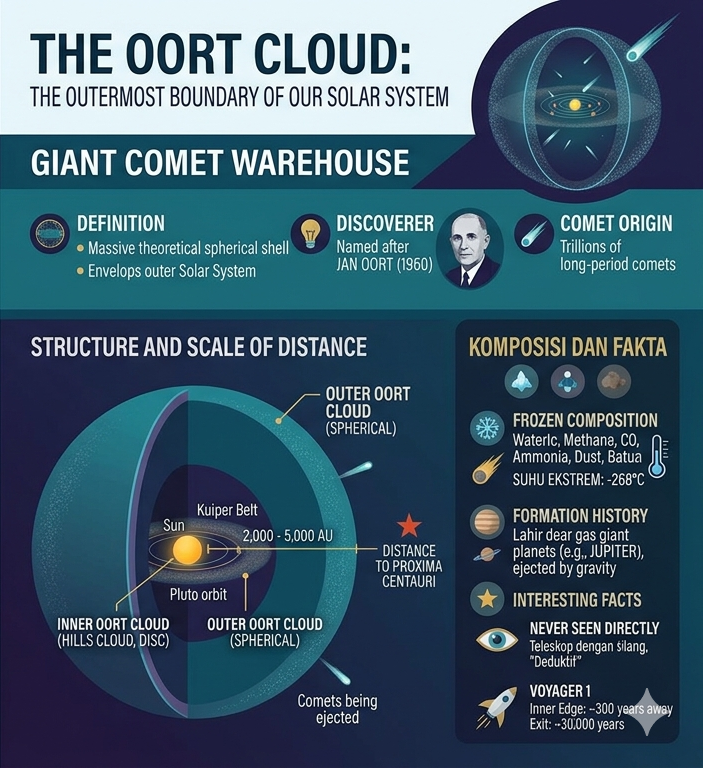
Here is the complete information about the Oort Cloud, the outermost boundary of our Solar System, translated into English.
What is the Oort Cloud?
The Oort Cloud is a giant, theoretical spherical shell surrounding the entire outer reaches of the Solar System. It is believed to be a “warehouse” of cosmic ice and the origin of trillions of long-period comets (comets that take hundreds to millions of years to orbit the Sun once). It is named after the Dutch astronomer Jan Oort, who predicted its existence in 1950.
Massive Distance and Size
The Oort Cloud is located at a distance that is almost beyond human comprehension, far beyond the Kuiper Belt and the dwarf planet Pluto.
Inner Edge: Begins at a distance of about 2,000 to 5,000 AU (Astronomical Units). One AU is the average distance from the Earth to the Sun (about 150 million kilometers).
Outer Edge: Extends incredibly far, up to 10,000 to 100,000 AU from the Sun. This outer edge is roughly equivalent to a quarter of the distance from the Sun to our nearest star, Proxima Centauri.
Scale Comparison: For perspective, the orbit of the dwarf planet Pluto is only about 30–50 AU away.
Structure of the Oort Cloud
The cloud does not have a single uniform shape but is divided into two main parts:
Outer Oort Cloud (Spherical): The outermost part, shaped like a spherical shell (enveloping from all directions). Objects here are very weakly bound by the Sun’s gravity, making them easily disturbed by passing stars or the gravitational pull of the Milky Way galaxy.
Inner Oort Cloud / Hills Cloud (Disc-shaped): The inner section is denser and somewhat flattened, like a giant donut or disc. This region is believed to be the main factory that continuously supplies objects to the outer Oort Cloud.
Composition and Temperature
Composition: Most of the Oort Cloud’s inhabitants are frozen debris left over from the early formation of the Solar System. They consist of rock, dust, and cosmic ices such as water ice, methane, ethane, carbon monoxide, and ammonia. Their sizes vary, from as small as pebbles to as large as massive mountains, or perhaps even dwarf planets.
Extreme Temperature: Because it receives virtually no light or heat from the Sun, the temperature in this region is incredibly extreme, reaching about -268°C (near absolute zero).
Formation History
Although currently located at the edge of the Solar System, the objects in the Oort Cloud did not actually form there. About 4.6 billion years ago, when the Solar System was first born, these icy bodies were originally located near the orbits of the gas giant planets (Jupiter, Saturn, Uranus, and Neptune). The massive gravity of those planets acted like a slingshot, hurling billions of these icy chunks into deep space. There, they eventually settled and formed the protective belt we call the Oort Cloud.
Other Interesting Facts
Never Seen Directly: Due to its immense distance, extremely faint light, and the slow movement of its objects, the Oort Cloud has never been successfully photographed or directly observed, even with the most advanced telescopes. Its existence is deduced from calculating the orbits of comets heading toward Earth.
Human Exploration Has Not Reached It: NASA’s Voyager 1 spacecraft, the furthest and fastest human-made object currently in space, will only reach the inner edge of the Oort Cloud in about 300 years. Furthermore, it will take the spacecraft roughly 30,000 years to completely exit this giant cloud!
Amir Maulana – SKYWORLD
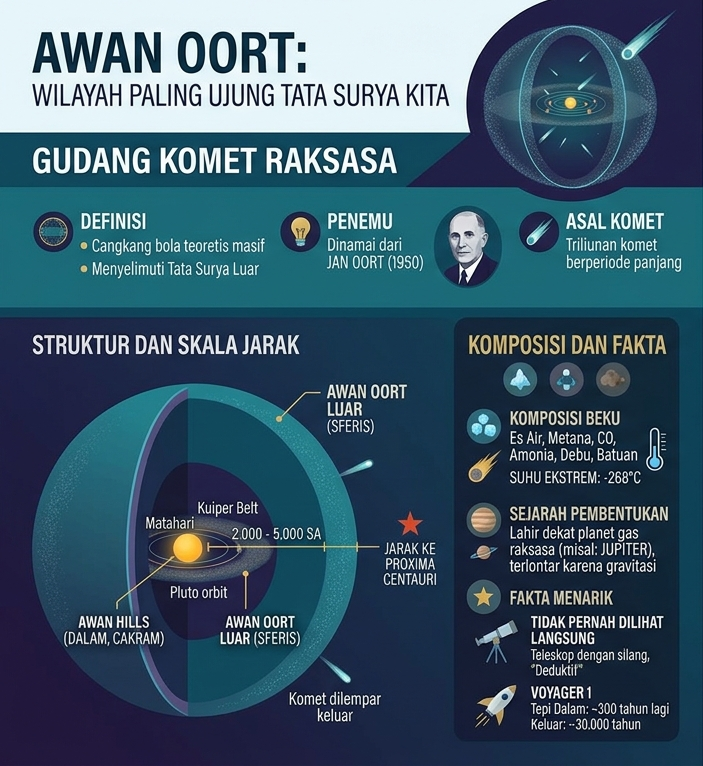
Berikut adalah informasi lengkap mengenai Awan Oort, batas wilayah paling ujung dari sistem Tata Surya kita.
Apa itu Awan Oort?
Awan Oort adalah wilayah teoretis raksasa berbentuk cangkang bola yang menyelimuti seluruh bagian terluar Tata Surya. Wilayah ini diyakini sebagai “gudang” penyimpanan es kosmik dan tempat asal triliunan komet berperiode panjang (komet yang butuh waktu ratusan hingga jutaan tahun untuk satu kali mengitari Matahari). Namanya diambil dari astronom Belanda, Jan Oort, yang memprediksi keberadaannya pada tahun 1950.
Jarak dan Ukuran yang Masif
Awan Oort berada di jarak yang sangat tidak terbayangkan oleh akal sehat manusia, jauh melampaui sabuk Kuiper dan planet Pluto.
Tepi Dalam: Dimulai pada jarak sekitar 2.000 hingga 5.000 SA (Satuan Astronomi). Satu SA adalah jarak rata-rata dari Bumi ke Matahari (sekitar 150 juta kilometer).
Tepi Luar: Membentang sangat jauh hingga 10.000 hingga 100.000 SA dari Matahari. Tepi luar ini setara dengan sekitar seperempat jarak dari Matahari ke bintang terdekat kita, Proxima Centauri.
Perbandingan Skala: Sebagai gambaran, orbit planet kerdil Pluto hanya berjarak sekitar 30–50 SA.
Struktur Awan Oort
Awan ini tidak memiliki bentuk tunggal, melainkan terbagi menjadi dua bagian utama:
Awan Oort Luar (Sferis): Bagian terluar yang berbentuk seperti cangkang bola (menyelimuti segala arah). Objek di sini terikat sangat lemah oleh gravitasi Matahari, sehingga mudah terganggu oleh bintang yang melintas atau tarikan gravitasi galaksi Bima Sakti.
Awan Oort Dalam / Awan Hills (Cakram): Bagian di sisi dalam yang lebih padat dan berbentuk agak pipih seperti donat atau cakram raksasa. Wilayah ini diyakini sebagai pabrik utama yang terus menyuplai objek ke Awan Oort luar.
Komposisi dan Suhu
Komposisi: Sebagian besar penghuni Awan Oort adalah sisa-sisa puing beku dari awal pembentukan Tata Surya. Mereka terdiri dari batuan, debu, dan es kosmik seperti air es, metana, etana, karbon monoksida, dan amonia. Ukurannya bervariasi, mulai dari sekecil kerikil hingga sebesar pegunungan raksasa, atau bahkan mungkin seukuran planet kerdil.
Suhu Ekstrem: Karena nyaris tidak mendapat cahaya dan panas Matahari, suhu di wilayah ini sangat ekstrem, mencapai sekitar -268°C (mendekati nol mutlak).
Sejarah Pembentukan
Meskipun letaknya sekarang berada di pinggiran Tata Surya, objek-objek di Awan Oort sebenarnya tidak terbentuk di sana. Sekitar 4,6 miliar tahun lalu, ketika Tata Surya baru saja lahir, objek-objek es ini awalnya berada di sekitar orbit planet-planet gas raksasa (Jupiter, Saturnus, Uranus, dan Neptunus). Gravitasi masif dari planet-planet tersebut kemudian bertindak seperti ketapel, melontarkan miliaran bongkahan es ini ke ruang angkasa yang sangat jauh. Di sanalah bongkahan tersebut akhirnya menetap dan membentuk sabuk pelindung yang kita sebut Awan Oort.
Fakta Menarik Lainnya
Belum Pernah Dilihat Langsung: Karena letaknya yang sangat jauh, cahayanya yang terlalu redup, dan objeknya yang lambat, Awan Oort belum pernah berhasil difoto atau diamati langsung dengan teleskop paling canggih sekalipun. Keberadaannya dibuktikan secara deduktif dari perhitungan orbit komet-komet yang datang ke arah Bumi.
Eksplorasi Manusia Belum Sampai: Wahana antariksa Voyager 1 milik NASA, benda buatan manusia yang melaju paling jauh dan paling cepat saat ini, baru akan menyentuh batas dalam Awan Oort dalam waktu sekitar 300 tahun lagi. Bahkan, wahana tersebut butuh waktu sekitar 30.000 tahun untuk bisa benar-benar keluar dari awan raksasa ini!
Amir Maulana – SKYWORLD