
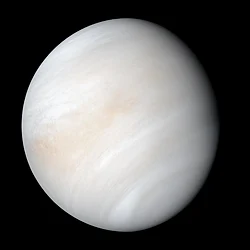
Venus . kredit : Wikipedia
Venus is often called Earth’s “twin” because of their similar size, but make no mistake—this planet is an absolute extreme and far different from our home.
Here are some unique facts about Venus that will make you see this “morning star” in a whole new light:
1. The Hottest Planet in the Solar System
Even though Mercury is closer to the Sun, Venus holds the title of the hottest planet. Its surface temperature averages around 460°C—hot enough to melt lead! This happens because its incredibly thick atmosphere traps heat in a runaway greenhouse effect.
2. The Sun Rises in the West
Venus has a retrograde rotation, meaning it spins on its axis in the opposite direction of most other planets (including Earth). If you could stand on its surface, the Sun would rise in the west and set in the east.
3. A Day is Longer Than a Year
Venus rotates very slowly on its axis. In fact, one full rotation (a sidereal day) takes 243 Earth days. Meanwhile, it completes one orbit around the Sun (a year) in just 225 Earth days. So, technically, a day on Venus lasts longer than its year!
4. Crushing Atmospheric Pressure
Standing on the surface of Venus would feel like being 900 meters underwater on Earth. Its atmospheric pressure is 90 times stronger than Earth’s—enough to crush a conventional submarine or a spacecraft within minutes.
5. Thousands of Volcanoes
Venus has more volcanoes than any other planet in the Solar System. Scientists have mapped over 1,600 major volcanoes, and there are likely millions of smaller ones. Some of them are believed to still be active today.
Other Quick Facts:
Sulfuric Acid Clouds: The clouds on Venus aren’t made of water; they are composed of highly corrosive sulfuric acid.
No Moons: Along with Mercury, Venus is one of the only two planets in our Solar System that does not have any natural satellites (moons).
Brightest Night Object: After the Moon, Venus is the brightest natural object in Earth’s night sky.
Amir Maulana – SKYWORLD
Venus sering disebut sebagai “kembaran” Bumi karena ukurannya yang mirip, tapi jangan salah—planet ini adalah tempat yang sangat ekstrem dan jauh berbeda dari rumah kita.
Berikut adalah beberapa fakta unik tentang Venus yang akan membuat Anda melihat bintang fajar ini dengan cara berbeda:
1. Planet Paling Panas di Tata Surya
Meskipun Merkurius berada lebih dekat ke Matahari, Venus memegang gelar sebagai planet terpanas. Suhu permukaannya rata-rata sekitar 460°C—cukup panas untuk melelehkan timah! Hal ini terjadi karena atmosfernya yang sangat tebal memerangkap panas dalam efek rumah kaca yang tak terkendali.
2. Matahari Terbit dari Barat
Venus memiliki rotasi retrograde, yang berarti ia berputar pada porosnya dengan arah yang berlawanan dari kebanyakan planet lain (termasuk Bumi). Jika Anda bisa berdiri di permukaannya, Matahari akan terbit dari barat dan tenggelam di timur.
3. Satu Hari Lebih Lama dari Satu Tahun
Venus berputar sangat lambat pada porosnya. Saking lambatnya, satu putaran penuh (satu hari sideris) membutuhkan waktu 243 hari Bumi. Sementara itu, ia menyelesaikan orbit mengelilingi Matahari (satu tahun) hanya dalam 225 hari Bumi. Jadi, secara teknis, hari di Venus lebih panjang daripada tahunnya!
4. Tekanan Atmosfer yang Menghancurkan
Berdiri di permukaan Venus rasanya seperti berada 900 meter di bawah permukaan laut Bumi. Tekanan atmosfernya 90 kali lebih kuat dari Bumi, yang cukup untuk menghancurkan kapal selam konvensional atau wahana antariksa dalam hitungan menit.
5. Ribuan Gunung Berapi
Venus memiliki gunung berapi lebih banyak dibandingkan planet lain di Tata Surya. Para ilmuwan telah memetakan lebih dari 1.600 gunung berapi besar, dan mungkin ada jutaan gunung berapi yang lebih kecil. Beberapa di antaranya diyakini masih aktif hingga saat ini.
Fakta Cepat Lainnya:
Awan Asam Sulfat: Awan di Venus bukan berisi air, melainkan asam sulfat yang sangat korosif.
Tanpa Bulan: Bersama Merkurius, Venus adalah satu-satunya planet di Tata Surya yang tidak memiliki satelit alami (bulan).
Benda Langit Terang: Setelah Bulan, Venus adalah objek alami paling terang di langit malam Bumi.
Amir Maulana – SKYWORLD