
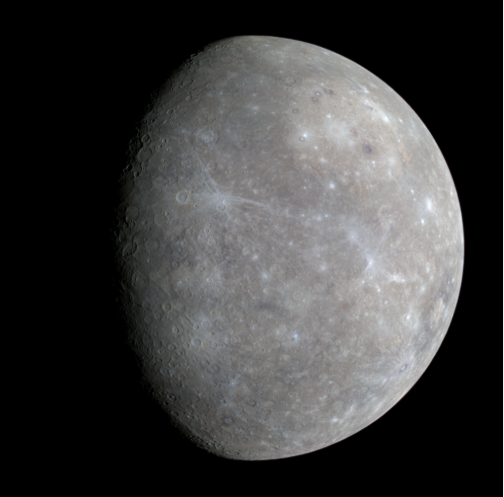
Mercury might be the smallest planet in our solar system, but it is packed with surprises that make it truly one of a kind. Being the closest planet to the Sun, it is far more than just a “hot ball of rock.”
Here are some unique facts about Mercury:
1. A Dense Little World
Despite being only slightly larger than the Moon, Mercury is the second densest planet in the solar system after Earth. This is because it has a massive metallic (iron) core that makes up about 85% of its radius. Essentially, Mercury is a “giant iron ball” wrapped in a thin rocky shell.
2. Extreme (Bipolar) Temperatures
Mercury lacks a thick atmosphere to trap heat. As a result, its temperature fluctuations are the most extreme in the solar system:
Daytime: Temperatures can soar to 430°C (hot enough to melt lead).
Nighttime: Temperatures plummet to -180°C.
3. Short Years, Long Days
Mercury moves incredibly fast around the Sun but rotates very slowly on its axis:
One year on Mercury (one orbit) lasts only 88 Earth days.
However, one solar day (from sunrise to the next sunrise) lasts 176 Earth days. This means a single day there is actually longer than its year!
4. A Comet-like “Tail”
Mercury has a very thin layer of gas called an exosphere. Because of its proximity to the Sun, solar wind pressure pushes atoms from this exosphere into a long tail that stretches for millions of kilometers—much like the tail of a comet.
5. Ice on the Second Hottest Planet
Despite the scorching daytime heat, scientists have discovered water ice at Mercury’s poles. This ice is hidden deep within craters that are permanently shadowed and never see sunlight.
6. The Shrinking Planet
Data from spacecraft shows that Mercury is actually getting smaller. As its iron core cools and solidifies, the planet’s surface wrinkles, creating massive cliffs (scarps) that can be thousands of meters high and hundreds of kilometers long.
It is a fascinating little planet that defies many of our expectations for a rocky world.
Amir Maulana – SKYWORLD
Merkurius mungkin adalah planet terkecil di tata surya kita, tapi jangan salah—planet ini punya banyak kejutan yang membuatnya sangat unik. Sebagai planet yang paling dekat dengan Matahari, Merkurius bukan sekadar “bola batu panas”.
Berikut adalah beberapa fakta unik tentang Merkurius:
1. Si Kecil yang Padat
Meskipun ukurannya hanya sedikit lebih besar dari Bulan, Merkurius adalah planet terpadat kedua setelah Bumi. Hal ini dikarenakan Merkurius memiliki inti logam (besi) yang sangat besar, mencakup sekitar 85% dari radius planet tersebut. Bisa dibilang, Merkurius adalah “bola besi raksasa” yang dibungkus lapisan tipis batu.
2. Suhu yang Ekstrem (Bipolar)
Merkurius tidak memiliki atmosfer yang tebal untuk memerangkap panas. Akibatnya, perubahan suhunya adalah yang paling ekstrem di tata surya:
Siang hari: Suhu bisa mencapai 430°C (cukup panas untuk melelehkan timah).
Malam hari: Suhu merosot tajam hingga -180°C.
3. Tahun yang Singkat, Hari yang Panjang
Merkurius bergerak sangat cepat mengelilingi Matahari, tetapi berputar sangat lambat pada porosnya:
Satu tahun di Merkurius (satu kali orbit) hanya berlangsung selama 88 hari Bumi.
Namun, satu hari matahari (dari matahari terbit ke matahari terbit berikutnya) berlangsung selama 176 hari Bumi. Jadi, satu hari di sana lebih lama daripada satu tahunnya!
4. Memiliki “Ekor” Seperti Komet
Merkurius memiliki eksosfer (lapisan gas yang sangat tipis). Karena jaraknya yang dekat dengan Matahari, tekanan angin surya mendorong atom-atom di eksosfer tersebut hingga membentuk ekor panjang yang membentang jutaan kilometer, mirip dengan ekor komet.
5. Es di Planet Terpanas Kedua
Walaupun suhu siangnya sangat menyengat, para ilmuwan menemukan adanya es air di kutub Merkurius. Es ini tersembunyi di dalam kawah-kawah dalam yang tidak pernah terkena sinar matahari (zona bayangan permanen).
6. Planet yang Terus Menyusut
Data dari wahana antariksa menunjukkan bahwa Merkurius terus mengecil. Karena inti besinya mendingin dan memadat, permukaan planet ini mengerut, menciptakan tebing-tebing raksasa (scarps) yang tingginya bisa mencapai ribuan meter dan panjang ratusan kilometer.
Planet ini memang kecil, tapi karakteristiknya benar-benar menantang logika kita tentang planet berbatu.
Amir Maulana – SKYWORLD