
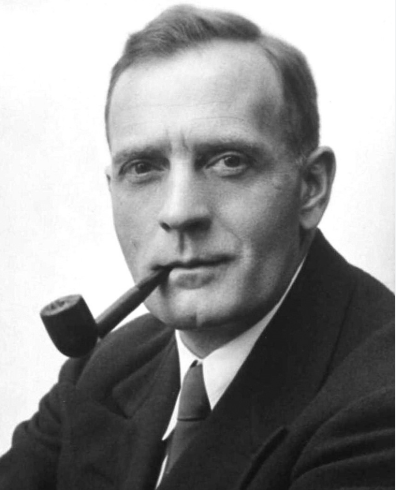
Edwin Powell Hubble (1889–1953) was one of the most influential astronomers of the 20th century. His discoveries fundamentally changed humanity’s understanding of the cosmos, proving that the universe is vastly larger than just the Milky Way and that it is expanding.
Early Life and Education
Youth: Born on November 20, 1889, in Marshfield, Missouri, USA. He was known as a bright student and a gifted athlete in his youth.
College: He earned a scholarship to the University of Chicago, where he studied mathematics, astronomy, and philosophy. He was also mentored by Nobel laureate physicist Robert Millikan and astronomer George Ellery Hale.
Oxford and Law: Fulfilling a promise to his ailing father, Hubble studied law at the University of Oxford, England, as part of the first class of Rhodes Scholars.
Return to Astronomy: After his father died, and following brief stints as a high school Spanish teacher and serving in World War I, Hubble returned to his true calling. He completed his doctoral studies (Ph.D.) in astronomy at the Yerkes Observatory, University of Chicago, in 1917.
Major Discoveries
Hubble spent most of his professional career at the Mount Wilson Observatory in California, using the 100-inch Hooker Telescope, which was the largest telescope in the world at the time.
1. Discovering Galaxies Beyond the Milky Way (1924)
Before Hubble, scientists believed the Milky Way constituted the entire universe and that the fuzzy patches of light in the night sky were merely clouds of gas called “nebulae” within our galaxy.
By observing Cepheid variable stars (stars whose brightness pulsates regularly) in the Andromeda Nebula, Hubble calculated that the distance to these “nebulae” was much too far to be inside the Milky Way. This discovery proved that Andromeda was a galaxy in its own right, and that our universe is populated by billions of other galaxies, or “island universes.”
2. Hubble’s Law and the Expanding Universe (1929)
Hubble measured the light spectra from these galaxies and found a redshift, indicating that they were moving away from Earth. He formulated what is now known as the Hubble-Lemaître Law, which states that the velocity at which a galaxy recedes is proportional to its distance from us. The equation is formulated as:

Where $v$ is the recession velocity of the galaxy, $H_0$ is the Hubble Constant, and $d$ is the distance to the galaxy. This provided the first observational evidence for the Big Bang theory, demonstrating that the universe is expanding.
3. Galaxy Classification (Hubble Tuning Fork)
To organize the various shapes of the galaxies he observed, Hubble created a morphological classification system that is still widely used by astronomers today. This system divides galaxies into three main categories: elliptical, spiral, and irregular.
Later Life and Legacy
Nobel Prize Campaign: Throughout his career, Hubble campaigned for astronomy to be recognized as a branch of physics by the Nobel Prize Committee so that astronomers could be eligible for the award. This campaign succeeded shortly after his death, but unfortunately, the Nobel Prize is not awarded posthumously.
Death: Edwin Hubble passed away from a cerebral thrombosis on September 28, 1953, in San Marino, California.
Greatest Tribute: His name is immortalized on the Hubble Space Telescope, launched by NASA in 1990. This telescope continues to revolutionize astrophysics and has provided some of the deepest views of the universe ever seen.
Amir Maulana – SKYWORLD
Edwin Powell Hubble (1889–1953) adalah salah satu astronom paling berpengaruh di abad ke-20. Penemuannya secara fundamental mengubah pemahaman umat manusia tentang kosmos, membuktikan bahwa alam semesta jauh lebih besar dari sekadar Bima Sakti dan bahwa alam semesta ini sedang mengembang.
Berikut adalah rincian lengkap mengenai kehidupan, karir, dan kontribusinya:
Kehidupan Awal dan Pendidikan
Masa Muda: Lahir pada 20 November 1889 di Marshfield, Missouri, Amerika Serikat. Ia dikenal sebagai siswa yang cerdas dan atlet yang berbakat di masa mudanya.
Perguruan Tinggi: Ia menerima beasiswa di Universitas Chicago, di mana ia belajar matematika, astronomi, dan filsafat. Ia juga dibimbing oleh fisikawan pemenang Hadiah Nobel, Robert Millikan, dan astronom George Ellery Hale.
Oxford dan Hukum: Memenuhi janji kepada ayahnya yang sedang sakit, Hubble menempuh pendidikan hukum di Universitas Oxford, Inggris, sebagai salah satu penerima Beasiswa Rhodes angkatan pertama.
Kembali ke Astronomi: Setelah ayahnya meninggal dan ia sempat bekerja sebagai guru bahasa Spanyol serta berdinas di Perang Dunia I, Hubble kembali ke panggilan sejatinya. Ia menyelesaikan studi doktoral (Ph.D.) di bidang astronomi di Observatorium Yerkes, Universitas Chicago pada tahun 1917.
Penemuan Terpenting
Hubble menghabiskan sebagian besar karir profesionalnya di Observatorium Mount Wilson di California, menggunakan Teleskop Hooker 100-inci yang saat itu merupakan teleskop terbesar di dunia.
1. Menemukan Galaksi di Luar Bima Sakti (1924)
Sebelum Hubble, para ilmuwan percaya bahwa Bima Sakti adalah keseluruhan alam semesta dan bahwa bercak cahaya kabur di langit malam hanyalah awan gas yang disebut “nebula” di dalam galaksi kita.
Dengan mengamati bintang variabel Cepheid (bintang yang kecerahannya berdenyut secara teratur) di Nebula Andromeda, Hubble menghitung bahwa jarak “nebula” tersebut terlalu jauh untuk berada di dalam Bima Sakti. Penemuan ini membuktikan bahwa Andromeda adalah galaksi tersendiri, dan alam semesta kita dipenuhi oleh miliaran galaksi lain atau “pulau alam semesta”.
2. Hukum Hubble dan Alam Semesta yang Mengembang (1929)
Hubble mengukur spektrum cahaya dari galaksi-galaksi tersebut dan menemukan pergeseran merah (redshift), yang mengindikasikan bahwa galaksi-galaksi tersebut bergerak menjauhi Bumi. Ia merumuskan apa yang sekarang dikenal sebagai Hukum Hubble-Lemaître, yang menyatakan bahwa kecepatan sebuah galaksi bergerak menjauh sebanding dengan jaraknya dari kita. Persamaan ini dirumuskan sebagai:
Di mana $v$ adalah kecepatan menjauh galaksi, $H_0$ adalah Konstanta Hubble, dan $d$ adalah jarak menuju galaksi tersebut. Ini adalah bukti observasional pertama dari teori Big Bang yang menunjukkan bahwa alam semesta sedang mengembang.
3. Klasifikasi Galaksi (Garpu Tala Hubble)
Untuk mengatur berbagai bentuk galaksi yang ia amati, Hubble menciptakan sistem klasifikasi morfologi yang masih digunakan secara luas oleh para astronom saat ini. Sistem ini membagi galaksi menjadi tiga kategori utama: elips, spiral, dan tak beraturan.
Akhir Hayat dan Warisan
Kampanye Hadiah Nobel: Sepanjang karirnya, Hubble berkampanye agar astronomi diakui sebagai cabang fisika oleh Komite Hadiah Nobel, sehingga astronom bisa mendapatkan penghargaan tersebut. Kampanye ini berhasil tak lama setelah kematiannya, namun Sayangnya Hadiah Nobel tidak diberikan secara anumerta.
Kematian: Edwin Hubble meninggal dunia karena stroke serebral pada 28 September 1953 di San Marino, California.
Penghormatan Terbesar: Namanya diabadikan pada Teleskop Luar Angkasa Hubble (Hubble Space Telescope) yang diluncurkan oleh NASA pada tahun 1990. Teleskop ini terus merevolusi astrofisika dan memberikan gambar-gambar alam semesta terdalam yang belum pernah dilihat sebelumnya.
Amir Maulana – SKYWORLD