
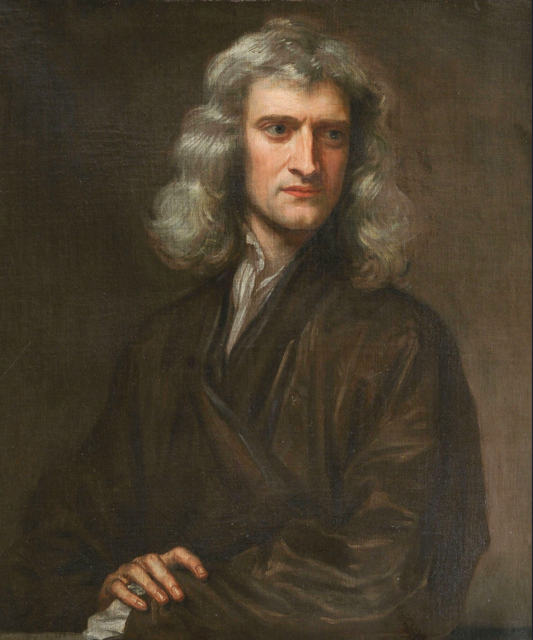
Sir Isaac Newton adalah salah satu ilmuwan paling berpengaruh dalam sejarah. Seorang ahli matematika, fisikawan, astronom, dan penulis asal Inggris, ia memainkan peran penting dalam Revolusi Ilmiah dan meletakkan dasar bagi fisika modern.
Berikut adalah rincian kontribusinya yang paling signifikan terhadap sains dan matematika:
1. Hukum Gerak
Dalam karya utamanya pada tahun 1687, Philosophiæ Naturalis Principia Mathematica (sering disebut Principia), Newton merumuskan tiga hukum gerak yang membentuk dasar mekanika klasik:
Hukum Pertama (Inersia): Benda yang diam akan tetap diam, dan benda yang bergerak akan tetap bergerak dengan kecepatan dan arah yang sama kecuali ada gaya tidak seimbang yang bekerja padanya.
Hukum Kedua (Gaya): Percepatan suatu benda bergantung pada massa benda dan besarnya gaya yang diberikan ($F = ma$).
Hukum Ketiga (Aksi dan Reaksi): Untuk setiap aksi, selalu ada reaksi yang sama besar dan berlawanan arah.
2. Gravitasi Universal
Terinspirasi—menurut legenda—dengan melihat sebuah apel jatuh dari pohon, Newton menyadari bahwa gaya yang sama yang menarik apel ke tanah juga menahan Bulan di orbitnya mengelilingi Bumi. Ia merumuskan hukum gravitasi universal, yang menyatakan bahwa setiap titik massa menarik setiap titik massa lainnya di alam semesta.
Persamaan matematis untuk ini adalah:
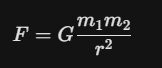
(Di mana $F$ adalah gaya gravitasi, $G$ adalah konstanta gravitasi, $m_1$ dan $m_2$ adalah massa, dan $r$ adalah jarak antara pusat-pusatnya.)
3. Pengembangan Kalkulus
Newton (bersama dengan, tetapi secara independen dari, ahli matematika Jerman Gottfried Wilhelm Leibniz) mengembangkan cabang matematika baru untuk membantu menjelaskan teorinya tentang gerak planet dan gravitasi. Ia menyebutnya “metode fluksion,” yang kita kenal sekarang sebagai kalkulus.
4. Optik dan Cahaya
Newton membuat penemuan inovatif di bidang optik. Dengan melewatkan seberkas cahaya putih melalui prisma kaca, ia membuktikan bahwa cahaya putih sebenarnya terdiri dari spektrum warna. Ia juga menemukan teleskop Newtonian, sebuah teleskop pemantul yang menggunakan cermin alih-alih lensa untuk menghindari masalah aberasi kromatik (distorsi warna) yang ditemukan pada teleskop awal.
Catatan tentang Tanggal
Anda mencatat 1642-1726. Di bawah kalender Julian “Gaya Lama” yang masih digunakan di Inggris pada masa hidupnya, ia lahir pada Hari Natal, 1642, dan meninggal pada Maret 1726. Di bawah kalender Gregorian modern yang kita gunakan saat ini, tanggalnya digeser menjadi 4 Januari 1643 – 31 Maret 1727.
Amir Maulana – SKYWORLD
Sir Isaac Newton was one of the most influential scientists in history. An English mathematician, physicist, astronomer, and author, he played a crucial role in the Scientific Revolution and laid the groundwork for modern physics.
Here is a breakdown of his most significant contributions to science and mathematics:
1. The Laws of Motion
In his 1687 masterwork, Philosophiæ Naturalis Principia Mathematica (often just called the Principia), Newton formulated three laws of motion that formed the foundation of classical mechanics:
First Law (Inertia): An object at rest stays at rest, and an object in motion stays in motion with the same speed and in the same direction unless acted upon by an unbalanced force.
Second Law (Force): The acceleration of an object depends on the mass of the object and the amount of force applied ($F = ma$).
Third Law (Action and Reaction): For every action, there is an equal and opposite reaction.
2. Universal Gravitation
Inspired—according to legend—by watching an apple fall from a tree, Newton realized that the same force pulling the apple to the ground also keeps the Moon in orbit around the Earth. He formulated the law of universal gravitation, which states that every point mass attracts every other point mass in the universe.
The mathematical equation for this is:
(Where $F$ is the gravitational force, $G$ is the gravitational constant, $m_1$ and $m_2$ are the masses, and $r$ is the distance between their centers.)
3. The Development of Calculus
Newton (alongside, but independently of, German mathematician Gottfried Wilhelm Leibniz) developed a new branch of mathematics to help explain his theories about planetary motion and gravity. He called it the “method of fluxions,” which we know today as calculus.
4. Optics and Light
Newton made groundbreaking discoveries in the field of optics. By passing a beam of white light through a glass prism, he proved that white light is actually composed of a spectrum of colors. He also invented the Newtonian telescope, a reflecting telescope that used mirrors instead of lenses to bypass the issue of chromatic aberration (color distortion) found in early telescopes.
A Note on the Dates
You noted 1642-1726. Under the “Old Style” Julian calendar that was still in use in England at the time of his life, he was born on Christmas Day, 1642, and died in March 1726. Under the modern Gregorian calendar we use today, his dates are shifted to January 4, 1643 – March 31, 1727.
Amir Maulana – SKYWORLD