
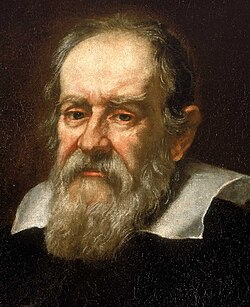
Gallileo Gallilei . Kredit : Wikipedia
Galileo Galilei (1564–1642) is one of the most influential figures in the history of science. Often called the “Father of Observational Astronomy,” the “Father of Modern Physics,” and the “Father of Science,” his contributions changed how humanity views the universe, shifting from philosophical dogma to observation-based scientific methods.
Here is a comprehensive breakdown of Galileo’s life, discoveries, and legacy:
Early Life and Education
Birth: Born on February 15, 1564, in Pisa, Duchy of Florence (now Italy). He was the eldest son of Vincenzo Galilei, a famous lutenist and music theorist.
Education: Initially, he enrolled at the University of Pisa to study medicine at his father’s urging. However, his interest quickly shifted to mathematics and natural philosophy after observing a swinging chandelier in the cathedral, which sparked his thoughts on the laws of pendulums.
The Astronomical Revolution and Telescopic Discoveries
Although Galileo did not invent the first telescope, he was the first to refine its design and systematically point it at the night sky. These observations shattered the geocentric view (Earth as the center of the universe) that had been believed for centuries.
Galilean Moons (1610): He discovered the four largest natural satellites orbiting the planet Jupiter: Io, Europa, Ganymede, and Callisto. This was the first undeniable proof that not all celestial bodies orbit the Earth.
Phases of Venus: Galileo observed that Venus goes through phases similar to the Moon (from crescent to full). This phenomenon was impossible under the Ptolemaic (geocentric) model of the solar system and provided strong empirical support for the Copernican heliocentric model (Sun as the center).
The Moon’s Surface: Before Galileo, the Moon was thought to be a smooth, perfect crystal sphere. His telescope revealed a landscape filled with craters, mountains, and valleys, proving that celestial bodies possess physical imperfections similar to Earth.
Sunspots and the Milky Way: He observed dark spots on the Sun (Sunspots) and concluded that the Sun rotates. He also discovered that the hazy band of the Milky Way actually consists of a densely packed collection of individual stars.
Contributions to Physics
Beyond astronomy, Galileo’s experiments laid the groundwork for classical mechanics:
Law of Falling Bodies: He refuted Aristotle’s theory by demonstrating that all objects, regardless of their mass, fall with the same acceleration in a vacuum (his legendary experiment is often associated with the Leaning Tower of Pisa, though some historians consider this a thought experiment).
Concept of Inertia: He formulated the early idea that an object moving on a flat surface will continue to move in the same direction at a constant speed unless disturbed by a force—a principle later refined by Isaac Newton as the First Law of Motion.
Conflict with the Catholic Church
Galileo’s public support for the heliocentric (Copernican) solar system model brought him into direct conflict with the Roman Catholic Church.
First Warning (1616): The Roman Inquisition declared that heliocentrism contradicted sacred texts. Galileo was ordered not to hold, teach, or defend the theory as absolute truth.
Trial (1633): After publishing the Dialogue Concerning the Two Chief World Systems in 1632, which openly defended Copernican views, Galileo was tried by the Inquisition.
House Arrest: He was found “vehemently suspect of heresy,” forced to recant his support for heliocentrism, and spent the rest of his life under house arrest at his villa in Arcetri, near Florence. (The Catholic Church only officially cleared him of these charges in 1992 under Pope John Paul II).
Major Written Works
Sidereus Nuncius (Starry Messenger, 1610): The first scientific treatise based on observations through a telescope.
Il Saggiatore (The Assayer, 1623): A polemical work regarding the nature of comets and the scientific method.
Dialogo sopra i due massimi sistemi del mondo (Dialogue Concerning the Two Chief World Systems, 1632): A discussion comparing the Copernican and Ptolemaic systems.
Discorsi e dimostrazioni matematiche, intorno a due nuove scienze (Discourses and Mathematical Demonstrations Relating to Two New Sciences, 1638): Written while under house arrest, summarizing his life’s work in physics and kinematics.
Galileo died on January 8, 1642, totally blind, but his vision paved the way for the age of enlightenment and the exploration of the cosmos as we know it today.
Amir Maulana – SKYWORLD
Galileo Galilei (1564–1642) adalah salah satu tokoh paling berpengaruh dalam sejarah ilmu pengetahuan. Sering dijuluki sebagai “Bapak Astronomi Observasional”, “Bapak Fisika Modern”, dan “Bapak Sains”, kontribusinya mengubah cara umat manusia memandang alam semesta, beralih dari dogma filosofis menuju metode ilmiah berbasis pengamatan.
Berikut adalah rincian komprehensif mengenai kehidupan, penemuan, dan warisan Galileo:
Kehidupan Awal dan Pendidikan
Kelahiran: Lahir pada 15 Februari 1564 di Pisa, Kadipaten Florence (sekarang Italia). Ia adalah anak tertua dari Vincenzo Galilei, seorang pemain lute terkenal dan ahli teori musik.
Pendidikan: Awalnya, ia mendaftar di Universitas Pisa untuk belajar kedokteran atas desakan ayahnya. Namun, ketertarikannya dengan cepat beralih ke matematika dan filsafat alam setelah mengamati ayunan lampu gantung di katedral, yang memicu pemikirannya tentang hukum pendulum.
Revolusi Astronomi dan Penemuan Teleskopik
Meskipun Galileo tidak merakit teleskop pertama, ia adalah orang pertama yang menyempurnakan desainnya dan mengarahkannya ke langit malam secara sistematis. Pengamatan ini meruntuhkan pandangan geosentris (Bumi sebagai pusat alam semesta) yang diyakini selama berabad-abad.
Bulan Galilea (1610): Ia menemukan empat satelit alami terbesar yang mengorbit planet Jupiter: Io, Europa, Ganymede, dan Callisto. Ini adalah bukti pertama yang tak terbantahkan bahwa tidak semua benda langit mengorbit Bumi.
Fase Venus: Galileo mengamati bahwa Venus mengalami fase-fase yang mirip dengan Bulan (dari sabit hingga purnama). Fenomena ini tidak mungkin terjadi dalam model sistem tata surya Ptolemeus (geosentris), dan memberikan dukungan empiris yang kuat untuk model heliosentris Copernicus (Matahari sebagai pusat).
Permukaan Bulan: Sebelum Galileo, Bulan dianggap sebagai bola kristal yang mulus dan sempurna. Teleskopnya mengungkapkan lanskap yang dipenuhi kawah, pegunungan, dan lembah, membuktikan bahwa benda langit memiliki ketidaksempurnaan fisik yang mirip dengan Bumi.
Bintik Matahari dan Bima Sakti: Ia mengamati bintik gelap di Matahari (Sunspots) dan menyimpulkan bahwa Matahari berotasi. Ia juga menemukan bahwa pita kabut Bima Sakti (Milky Way) sebenarnya terdiri dari kumpulan bintang-bintang individu yang sangat padat.
Kontribusi pada Fisika
Selain astronomi, eksperimen Galileo meletakkan dasar bagi mekanika klasik:
Hukum Benda Jatuh: Ia membantah teori Aristoteles dengan mendemonstrasikan bahwa semua benda, terlepas dari massanya, jatuh dengan percepatan yang sama dalam ruang hampa (eksperimen legendarisnya sering dikaitkan dengan Menara Miring Pisa, meskipun sebagian sejarawan menganggap ini sebagai eksperimen pikiran).
Konsep Inersia: Ia merumuskan gagasan awal bahwa sebuah benda yang bergerak di permukaan datar akan terus bergerak ke arah yang sama dengan kecepatan konstan kecuali ada gaya yang mengganggunya, sebuah prinsip yang kemudian disempurnakan oleh Isaac Newton sebagai Hukum Gerak Pertama.
Konflik dengan Gereja Katolik
Dukungan publik Galileo terhadap model tata surya heliosentris (Copernican) membawanya ke dalam konflik langsung dengan Gereja Katolik Roma.
Peringatan Pertama (1616): Inkuisisi Romawi menyatakan bahwa heliosentrisme bertentangan dengan teks suci. Galileo diperintahkan untuk tidak meyakini, mengajarkan, atau mempertahankan teori tersebut sebagai kebenaran mutlak.
Pengadilan (1633): Setelah menerbitkan Dialogue Concerning the Two Chief World Systems (Dialog Mengenai Dua Sistem Dunia Utama) pada 1632, yang secara terang-terangan membela pandangan Copernicus, Galileo diadili oleh Inkuisisi.
Tahanan Rumah: Ia dinyatakan “sangat dicurigai melakukan bidah”, dipaksa untuk menarik kembali dukungannya terhadap heliosentrisme, dan menghabiskan sisa hidupnya sebagai tahanan rumah di vilanya di Arcetri, dekat Florence. (Gereja Katolik baru secara resmi membebaskannya dari tuduhan ini pada tahun 1992 di bawah Paus Yohanes Paulus II).
Karya Tulis Utama
Sidereus Nuncius (Utusan Bintang, 1610): Risalah ilmiah pertama berdasarkan pengamatan melalui teleskop.
Il Saggiatore (Sang Penimbang, 1623): Karya polemik mengenai sifat komet dan metode ilmiah.
Dialogo sopra i due massimi sistemi del mondo (1632): Diskusi yang membandingkan sistem Copernicus dan Ptolemeus.
Discorsi e dimostrazioni matematiche, intorno a due nuove scienze (Dua Ilmu Baru, 1638): Ditulis saat tahanan rumah, merangkum karya hidupnya di bidang fisika dan kinematika.
Galileo meninggal pada 8 Januari 1642 dalam keadaan buta total, namun pandangannya telah membuka jalan bagi era pencerahan dan eksplorasi kosmos yang kita kenal hari ini.
Amir Maulana – SKYWORLD