
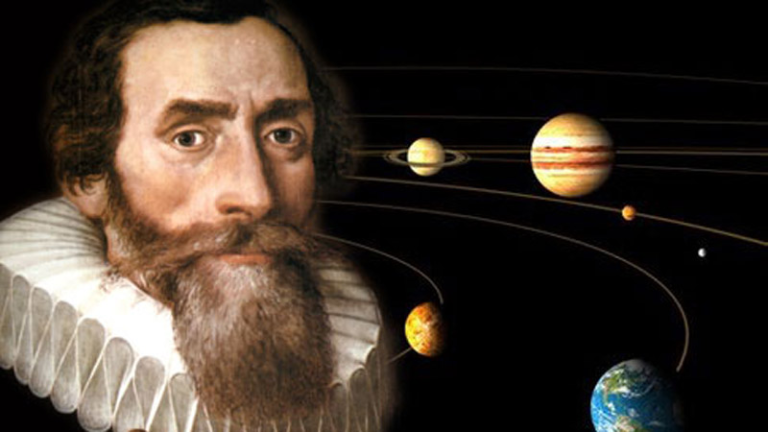
Johanes Kepler.Kredit: Wikipedia
Johannes Kepler (1571–1630 CE) was a German astronomer, mathematician, and astrologer who became one of the most crucial figures in the 17th-century Scientific Revolution. He is best known for his discovery of the Laws of Planetary Motion, which fundamentally changed how humanity understood the solar system.
Here is the complete information regarding the life, discoveries, and legacy of Johannes Kepler translated into English:
Early Life and Education
Birth: Born on December 27, 1571, in Weil der Stadt, Württemberg, Holy Roman Empire (now part of Germany).
Background: He came from a poor family; his father was a mercenary who left the family when Kepler was young, and his mother was a healer (who was later briefly accused of witchcraft).
Education: He was a brilliant child and received a scholarship to study theology at the University of Tübingen. It was there that he was introduced to the heliocentric (Sun-centered) system of Nicolaus Copernicus by his teacher, Michael Maestlin. Kepler became one of the earliest and most vocal supporters of the Copernican system.
Turning Point: Collaboration with Tycho Brahe
In 1600, Kepler moved to Prague to become an assistant to the eccentric but highly meticulous Danish astronomer, Tycho Brahe.
Brahe possessed the most accurate observational data of planetary positions (especially Mars) of that era, prior to the invention of the telescope.
When Brahe died suddenly in 1601, Kepler was appointed to succeed him as the Imperial Mathematician to the Holy Roman Emperor, Rudolph II.
Inheriting a treasure trove of Brahe’s observational data, Kepler spent years analyzing the movement of the planet Mars, which ultimately led him to his greatest breakthrough.
Kepler’s Three Laws of Planetary Motion
Before Kepler, astronomers (including Copernicus) believed that planets moved in perfectly circular orbits. Kepler’s mathematical analysis of Brahe’s data proved that view wrong. He formulated the following three laws:
Kepler’s First Law (The Law of Ellipses, 1609): The orbit of every planet around the Sun is an ellipse, with the Sun located at one of the two foci.
Kepler’s Second Law (The Law of Equal Areas, 1609): An imaginary line drawn from the center of the sun to the center of the planet will sweep out equal areas in equal intervals of time. This means a planet moves faster when it is closer to the Sun (perihelion) and slower when it is further away (aphelion).
Kepler’s Third Law (The Law of Harmonies, 1619): The square of a planet’s orbital period is proportional to the cube of its average distance from the Sun (the semi-major axis). Mathematically written as:
$T^2 \propto r^3$
Where $T$ is the orbital period and $r$ is the average distance to the Sun. This law demonstrates a proportional mathematical relationship between all the planets in the solar system.
Important Written Works
Mysterium Cosmographicum (The Cosmographic Mystery, 1596): The first published defense of the Copernican system.
Astronomia Nova (New Astronomy, 1609): The book containing the discovery of Kepler’s First and Second Laws of planetary motion.
Harmonices Mundi (The Harmony of the World, 1619): Discusses harmony and mathematical proportions in the universe, containing Kepler’s Third Law.
Epitome Astronomiae Copernicanae (Epitome of Copernican Astronomy, 1617–1621): One of the most influential astronomy texts of the 17th century, explaining the heliocentric system very systematically.
Contributions in Other Fields
Besides planetary motion, Kepler also made major contributions in other fields:
Optics: Often referred to as the father of modern optics. He explained the process of how the human eye focuses light, designed a new and improved type of telescope (the Keplerian telescope, utilizing two convex lenses), and explained the working principles of the camera obscura.
Mathematics: He contributed to the early development of integral calculus by calculating the volume of solids of revolution (like wine barrels) and extensively studied polygons and polyhedra.
Supernova: In 1604, he observed and recorded the appearance of a new supernova (now known as Kepler’s Supernova), proving that the universe was not static and unchanging as had been believed since the time of Aristotle.
Later Life and Legacy
Kepler lived during a tumultuous time caused by the Thirty Years’ War in Europe, which forced him to frequently move between cities to avoid religious persecution and financial troubles. He died on November 15, 1630, in Regensburg, Bavaria. His grave was destroyed during the war, but the epitaph he wrote for himself is still remembered: “I used to measure the heavens, now I measure the shadows of Earth.”
Kepler’s laws laid a very strong mathematical foundation for modern astronomy. Decades later, Isaac Newton used these laws to formulate his theory of universal gravitation.
Amir Maulana – SKYWORLD
Johannes Kepler (1571–1630 M) adalah seorang astronom, matematikawan, dan astrolog asal Jerman yang menjadi salah satu tokoh paling krusial dalam Revolusi Ilmiah abad ke-17. Ia paling dikenal melalui penemuannya mengenai Hukum Gerak Planet, yang mengubah cara umat manusia memahami tata surya secara fundamental.
Berikut adalah informasi lengkap mengenai kehidupan, penemuan, dan warisan Johannes Kepler:
Kehidupan Awal dan Pendidikan
Kelahiran: Lahir pada 27 Desember 1571 di Weil der Stadt, Württemberg, Kekaisaran Romawi Suci (sekarang bagian dari Jerman).
Latar Belakang: Berasal dari keluarga miskin; ayahnya adalah seorang tentara bayaran yang meninggalkan keluarga saat Kepler masih kecil, dan ibunya adalah seorang tabib (yang kelak sempat dituduh sebagai penyihir).
Pendidikan: Ia merupakan anak yang cerdas dan mendapat beasiswa untuk belajar teologi di Universitas Tübingen. Di sanalah ia diperkenalkan pada sistem heliosentris (Matahari sebagai pusat) gagasan Nicolaus Copernicus oleh gurunya, Michael Maestlin. Kepler menjadi salah satu pendukung awal dan paling vokal dari sistem Copernicus.
Titik Balik: Kolaborasi dengan Tycho Brahe
Pada tahun 1600, Kepler pindah ke Praha untuk menjadi asisten astronom Denmark yang eksentrik namun sangat teliti, Tycho Brahe.
Brahe memiliki data observasi posisi planet (terutama Mars) yang paling akurat pada masa itu, sebelum teleskop ditemukan.
Ketika Brahe meninggal secara mendadak pada tahun 1601, Kepler ditunjuk untuk menggantikannya sebagai Matematikawan Kekaisaran untuk Kaisar Romawi Suci, Rudolph II.
Dengan mewarisi harta karun berupa data observasi Brahe, Kepler menghabiskan bertahun-tahun menganalisis pergerakan planet Mars, yang akhirnya menuntunnya pada terobosan terbesarnya.
Tiga Hukum Gerak Planet Kepler
Sebelum Kepler, para astronom (termasuk Copernicus) meyakini bahwa planet bergerak dalam orbit melingkar sempurna. Analisis matematis Kepler terhadap data Brahe membuktikan bahwa pandangan tersebut keliru. Ia merumuskan tiga hukum berikut:
Hukum I Kepler (Hukum Elips, 1609): Orbit setiap planet mengelilingi Matahari berbentuk elips, dengan Matahari berada di salah satu titik fokus (foci) elips tersebut.
- Hukum II Kepler (Hukum Luas Area Sama, 1609): Sebuah garis imajiner yang ditarik dari Matahari ke planet akan menyapu luas area yang sama dalam interval waktu yang sama. Artinya, planet bergerak lebih cepat saat berada lebih dekat dengan Matahari (perihelion) dan lebih lambat saat menjauh (aphelion).
Hukum III Kepler (Hukum Harmoni, 1619): Kuadrat periode orbit suatu planet sebanding dengan pangkat tiga dari jarak rata-ratanya ke Matahari (setengah sumbu panjang atau semi-major axis). Secara matematis ditulis sebagai:
$T^2 \propto r^3$
Di mana $T$ adalah periode orbit dan $r$ adalah jarak rata-rata ke Matahari. Hukum ini menunjukkan hubungan matematis yang proporsional antara semua planet di tata surya.
Karya Tulis Penting
Mysterium Cosmographicum (Misteri Kosmografis, 1596): Pembelaan publik pertama terhadap sistem Copernicus.
Astronomia Nova (Astronomi Baru, 1609): Buku yang memuat penemuan Hukum Pertama dan Kedua Kepler tentang gerak planet.
Harmonices Mundi (Harmoni Dunia, 1619): Membahas harmoni dan proporsi matematis di alam semesta, yang memuat Hukum Ketiga Kepler.
Epitome Astronomiae Copernicanae (Epitome Astronomi Copernicus, 1617–1621): Salah satu teks astronomi paling berpengaruh di abad ke-17 yang menjelaskan sistem heliosentris dengan sangat sistematis.
Kontribusi di Bidang Lain
Selain gerak planet, Kepler juga memberikan kontribusi besar di bidang lain:
Optik: Sering disebut sebagai bapak optik modern. Ia menjelaskan proses bagaimana mata manusia memfokuskan cahaya, merancang jenis teleskop baru yang lebih baik (Teleskop Keplerian dengan dua lensa cembung), dan menjelaskan prinsip kerja kamera obskura.
Matematika: Ia berkontribusi pada pengembangan kalkulus integral dengan menghitung volume benda putar (seperti tong anggur) dan mempelajari poligon serta polihedra secara mendalam.
Supernova: Pada tahun 1604, ia mengamati dan mencatat munculnya supernova baru (sekarang dikenal sebagai Supernova Kepler), membuktikan bahwa alam semesta tidaklah statis dan tidak berubah seperti yang diyakini sejak zaman Aristoteles.
Akhir Hayat dan Warisan
Kepler hidup di masa yang penuh gejolak akibat Perang Tiga Puluh Tahun di Eropa, yang membuatnya sering berpindah-pindah kota untuk menghindari penganiayaan agama dan masalah keuangan. Ia meninggal pada 15 November 1630 di Regensburg, Bavaria. Makamnya hancur selama perang, tetapi epitaf yang ia tulis sendiri tetap dikenang: “Dulu aku mengukur langit, kini aku mengukur bayangan bumi.”
Hukum-hukum Kepler meletakkan dasar matematis yang sangat kuat bagi astronomi modern. Beberapa dekade kemudian, Isaac Newton menggunakan hukum-hukum Kepler ini untuk merumuskan teori gravitasi universalnya.
Amir Maulana – SKYWORLD