
Short Profile
Full Name: Abu Abdullah Muhammad ibn Jabir ibn Sinan al-Raqqi al-Harrani as-Sabi al-Battani
Latin Name: Albategnius, Albategni, or Albatenius
Birth: Around 858 AD in Harran (present-day Turkey)
Death: 929 AD near Samarra (Iraq)
Epithet: “Ptolemy of the Arabs”
Biography
Al-Battani was born into a family affiliated with the Sabian sect, a group in Harran that had a strong tradition of studying the stars. Although his ancestors were Sabians, the name “Abu Abdullah Muhammad” indicates that he was a Muslim.
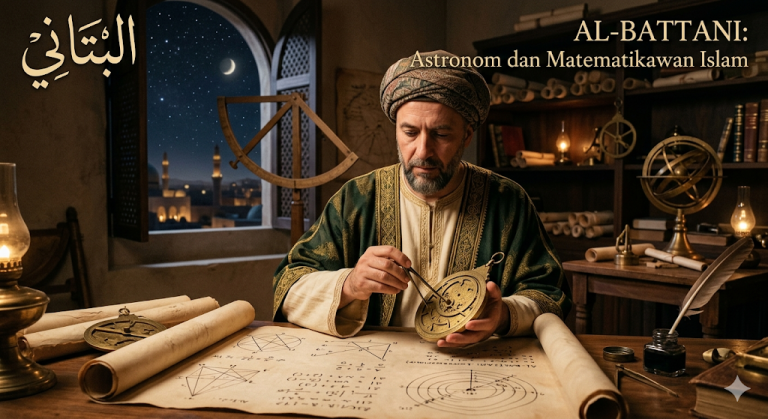
He spent most of his life conducting observations and research in the city of Raqqa (now in Syria) from 877 to 918 AD. Thanks to his observatory in Raqqa, supported by instruments of his own making, his observations of the sky were known to be incredibly precise for his time.
Major Contributions to Astronomy
Al-Battani made significant corrections to the works of ancient Greek astronomers, especially Ptolemy’s book, the Almagest. Some of his most influential astronomical discoveries include:
Solar Year Calculation: He calculated the length of a solar year (the time it takes for the Earth to orbit the Sun) with remarkable accuracy, specifically 365 days, 5 hours, 46 minutes, and 24 seconds. This figure is only about two minutes off from modern calculations.
Earth’s Axial Tilt: He calculated the obliquity of the ecliptic (the angle of the Earth’s tilt relative to its orbital plane) and arrived at 23° 35′.
Precession of the Equinoxes: He improved upon Ptolemy’s calculations regarding the slow movement of the Earth’s rotational axis (precession of the equinoxes) with much higher accuracy.
Solar Orbit: Al-Battani discovered that the direction of the Sun’s apogee (the point where the Sun is farthest from Earth) could change, proving that the Sun’s orbit is not completely fixed as previously believed.
Contributions to Mathematics (Trigonometry)
Although he is better known as an astronomer, his contributions to mathematics were crucial because he shifted astronomical methods from geometry to trigonometry.
Replacing the Chord System: Ptolemy used a complex system of chords. Al-Battani popularized the use of the sine function and proved its effectiveness in calculating the distances and positions of celestial bodies.
Introducing New Concepts: He was one of the first scientists to develop concepts and tables for the tangent (which he referred to as an “extended shadow”) and the cotangent.
Trigonometric Relationships: He discovered fundamental equations for calculating angular positions, which became the foundation for modern spherical trigonometry.
Key Works and Legacy
His greatest work is the Kitab az-Zij (or Zij as-Sabi), a comprehensive astronomical encyclopedia and set of tables containing 57 chapters. This book was translated into Latin in the 12th century under the title De Motu Stellarum (On the Motion of the Stars).
His Influence in Europe:
His work became a primary reference for European astronomers for centuries, including Nicolaus Copernicus, Tycho Brahe, Johannes Kepler, and Galileo Galilei. Copernicus even mentioned Al-Battani’s name (as Albategnius) numerous times in his monumental work, De revolutionibus orbium coelestium.
As a tribute to his contributions, a crater on the surface of the Moon is named the Albategnius crater.
Amir maulana – SKYWORLD
Profil Singkat
Nama Lengkap: Abu Abdullah Muhammad ibn Jabir ibn Sinan al-Raqqi al-Harrani as-Sabi al-Battani
Nama Latin: Albategnius, Albategni, atau Albatenius
Lahir: Sekitar tahun 858 M di Harran (sekarang berada di wilayah Turki)
Meninggal: 929 M di dekat Samarra (Irak)
Julukan: “Ptolemeus dari Arab” (Ptolemy of the Arabs)
Riwayat Hidup
Al-Battani lahir dalam keluarga yang berafiliasi dengan sekte Sabian, sebuah kelompok di Harran yang memiliki tradisi kuat dalam mempelajari bintang-bintang. Meskipun leluhurnya adalah penganut Sabian, nama “Abu Abdullah Muhammad” menunjukkan bahwa ia adalah seorang Muslim.
Ia menghabiskan sebagian besar masa hidupnya untuk melakukan observasi dan penelitian di kota Raqqa (kini di Suriah) dari tahun 877 hingga 918 M. Berkat observatorium di Raqqa yang didukung oleh instrumen-instrumen buatannya sendiri, pengamatannya terhadap langit dikenal sangat presisi pada zamannya.
Kontribusi Utama di Bidang Astronomi
Al-Battani memberikan koreksi yang signifikan terhadap karya-karya astronom Yunani kuno, terutama buku Almagest karangan Ptolemeus. Beberapa penemuan astronominya yang paling berpengaruh meliputi:
Perhitungan Tahun Matahari: Ia menghitung panjang satu tahun matahari (waktu yang dibutuhkan Bumi untuk mengelilingi Matahari) secara luar biasa akurat, yaitu 365 hari, 5 jam, 46 menit, dan 24 detik. Angka ini hanya selisih sekitar dua menit dari perhitungan modern.
Kemiringan Sumbu Bumi: Ia menghitung kemiringan ekliptika (sudut kemiringan Bumi terhadap bidang orbitnya) dan mendapatkan angka 23° 35′.
Presesi Ekuinoks: Ia memperbaiki perhitungan Ptolemeus tentang pergerakan lambat sumbu rotasi Bumi (presesi ekuinoks) dengan akurasi yang lebih tinggi.
Orbit Matahari: Al-Battani menemukan bahwa arah apogee Matahari (titik terjauh Matahari dari Bumi) dapat berubah, yang membuktikan bahwa orbit Matahari tidak sepenuhnya tetap seperti yang diyakini sebelumnya.
Kontribusi di Bidang Matematika (Trigonometri)
Meskipun lebih dikenal sebagai astronom, kontribusinya di bidang matematika sangat krusial karena ia mengubah metode astronomi dari geometri menjadi trigonometri.
Mengganti Sistem Tali Busur (Chords): Ptolemeus menggunakan sistem tali busur yang rumit. Al-Battani mempopulerkan penggunaan sinus (sine) dan membuktikan efektivitasnya dalam perhitungan jarak dan posisi benda langit.
Mengenalkan Konsep Baru: Ia adalah salah satu ilmuwan pertama yang mengembangkan konsep dan tabel untuk tangen (yang ia sebut sebagai “bayangan”) dan kotangen.
Hubungan Trigonometri: Ia menemukan persamaan mendasar untuk menghitung posisi sudut, yang menjadi fondasi bagi trigonometri sferis modern.
Karya Penting dan Warisan
Karya terbesarnya adalah Kitab az-Zij (atau Zij as-Sabi), sebuah ensiklopedia dan tabel astronomi komprehensif yang berisi 57 bab. Buku ini diterjemahkan ke dalam bahasa Latin pada abad ke-12 dengan judul De Motu Stellarum (Tentang Pergerakan Bintang-Bintang).
Pengaruhnya di Eropa:
Karyanya menjadi rujukan utama bagi para astronom Eropa selama berabad-abad, termasuk Nicolaus Copernicus, Tycho Brahe, Johannes Kepler, dan Galileo Galilei. Copernicus bahkan menyebut nama Al-Battani (sebagai Albategnius) berkali-kali dalam karya monumentalnya, De revolutionibus orbium coelestium.
Sebagai bentuk penghormatan atas jasanya, sebuah kawah di permukaan Bulan diberi nama Kawah Albategnius.
Amir Maulana – SKYWORLD