
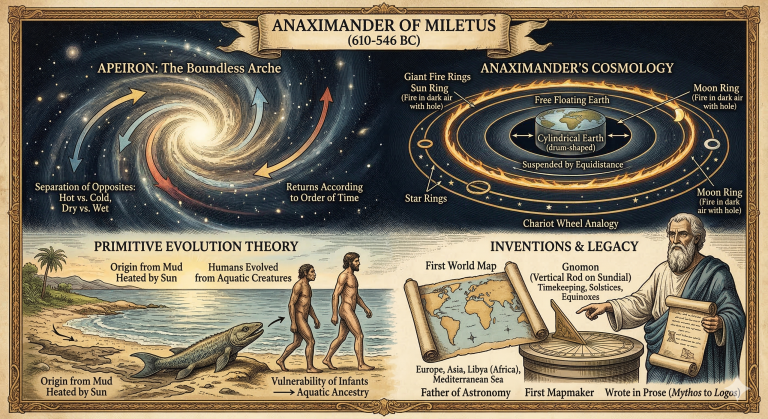
Anaximander (Anaximandros) was one of the most radical figures in the history of Western thought. As a student of Thales (the first philosopher), he did not merely follow in his teacher’s footsteps; he dared to challenge his teacher’s logic to build a significantly more complex cosmological system.
Here is the complete information regarding his contributions and philosophy:
1. The Concept of Apeiron (The First Principle)
While Thales believed Water was the origin of all things (Arche), Anaximander argued that the primary principle could not be a specific physical element.
The Logic: If the Arche were water, then its opposite (fire) could never exist because it would be extinguished by the water.
Apeiron: He proposed the concept of Apeiron, something infinite, boundless, formless, and eternal. Everything emerges from the Apeiron through the separation of opposite qualities (hot-cold, dry-wet) and eventually returns to it according to the “order of time.”
2. Model of the Universe (Cosmology)
Anaximander is often called the “Father of Astronomy” because he was the first to attempt to explain celestial mechanics using geometry rather than mythology.
The Floating Earth: He argued that the Earth is a cylinder (shaped like a drum) located at the center of the universe. Remarkably, he stated that the Earth remains in place not because it is supported by something (like Atlas or water), but because of its equidistance (balance of position) from all directions.
Celestial Bodies: He imagined the sun, moon, and stars as giant rings of fire enclosed in dark air, with small holes that emit light (similar to the holes in a chariot wheel).
3. Primitive Theory of Evolution
Long before Charles Darwin, Anaximander speculated about the origins of humanity based on sharp biological observations.
Origin from Water: He believed that the first life forms emerged from mud heated by the sun.
Humans and Fish: He observed that human infants are incredibly vulnerable and require long periods of protection to survive. Therefore, he concluded that humans must have evolved from other creatures (resembling fish or aquatic life) that were better able to protect themselves until humans were strong enough to live on land.
4. Inventions and Monumental Works
Anaximander was not just an abstract thinker; he was a practical scientist:
The First World Map: He is credited as the first person to attempt to draw a map of the world known at the time (Europe, Asia, and Libya/Africa).
The Gnomon: He introduced the gnomon (the vertical rod of a sundial) to Greece to determine solstices, equinoxes, and time.
The First Prose Writer: He was among the first to write down philosophical thoughts in prose rather than religious poetry, marking the transition from Mythos (myth) to Logos (logic).
Summary of Philosophy
| Aspect | Explanation |
| Arche | Apeiron (The Boundless/Infinite) |
| Shape of the Earth | Cylindrical, floating freely due to balance |
| Evolution | Humans originated from aquatic creatures |
| Legacy | Use of mathematical models to explain nature |
Amir Maulana – SKYWORLD
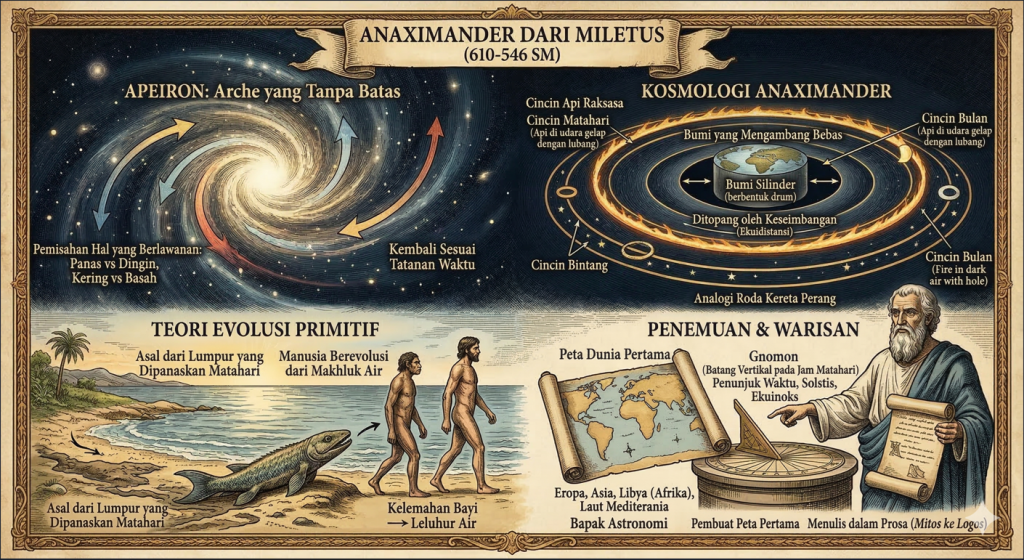
Anaximander (Anaximandros) adalah salah satu tokoh paling radikal dalam sejarah pemikiran Barat. Sebagai murid dari Thales (filsuf pertama), ia tidak hanya sekadar meneruskan tradisi gurunya, tetapi berani mematahkan logika gurunya untuk membangun sistem kosmologi yang jauh lebih kompleks.
Berikut adalah informasi lengkap mengenai kontribusi dan pemikirannya:
1. Konsep Apeiron (Prinsip Dasar Alam)
Jika Thales menganggap Air sebagai asal usul segala sesuatu (Arche), Anaximander berargumen bahwa prinsip dasar tidak mungkin berupa elemen fisik yang spesifik.
Logika: Jika Arche adalah air, maka api (lawannya) tidak akan pernah bisa ada karena akan dipadamkan oleh air.
Apeiron: Ia mengusulkan konsep Apeiron, sesuatu yang tak terbatas, tak berbentuk, dan abadi. Dari Apeiron inilah segala sesuatu muncul melalui pemisahan kualitas yang berlawanan (panas-dingin, kering-basah) dan pada akhirnya akan kembali ke sana sesuai dengan tatanan waktu.
2. Model Alam Semesta (Kosmologi)
Anaximander sering disebut sebagai “Bapak Astronomi” karena ia adalah orang pertama yang mencoba menjelaskan mekanika langit secara geometris, bukan mitologis.
Bumi yang Mengambang: Ia berpendapat bahwa Bumi berbentuk silinder (seperti drum) yang berada di pusat alam semesta. Hebatnya, ia menyatakan Bumi tetap di tempatnya bukan karena ditopang oleh sesuatu (seperti atlas atau air), melainkan karena keseimbangan posisi (ekuidistansi) dari segala arah.
Benda Langit: Ia membayangkan matahari, bulan, dan bintang sebagai cincin api raksasa yang tertutup udara gelap, dengan lubang-lubang kecil yang memancarkan cahaya (seperti lubang pada roda kereta).
3. Teori Evolusi Primitif
Jauh sebelum Charles Darwin, Anaximander sudah berspekulasi tentang asal-usul manusia berdasarkan observasi biologis yang tajam.
Asal dari Air: Ia berpendapat bahwa kehidupan pertama muncul dari lumpur yang dipanaskan oleh matahari.
Manusia dan Ikan: Ia mengamati bahwa bayi manusia sangat lemah dan butuh perlindungan lama untuk bertahan hidup. Maka, ia menyimpulkan bahwa manusia pastilah berevolusi dari makhluk lain (sejenis ikan atau makhluk air) yang lebih mampu melindungi dirinya sendiri hingga manusia cukup kuat untuk hidup di darat.
4. Penemuan dan Karya Monumental
Anaximander bukan sekadar pemikir abstrak; ia adalah seorang ilmuwan praktis:
Peta Dunia Pertama: Ia dianggap sebagai orang pertama yang mencoba menggambar peta dunia yang diketahui saat itu (Eropa, Asia, dan Libya/Afrika).
Gnomon: Ia memperkenalkan gnomon (tongkat penunjuk pada jam matahari) ke Yunani untuk menentukan titik balik matahari, ekuinoks, dan waktu.
Penulis Prosa Pertama: Ia adalah salah satu orang pertama yang menuliskan pemikiran filsafatnya dalam bentuk prosa, bukan puisi religius, yang menandai transisi dari mitos menuju logos (logika).
Ringkasan Pemikiran
| Aspek | Penjelasan |
| Arche | Apeiron (Sesuatu yang tak terbatas) |
| Bentuk Bumi | Silinder, mengambang bebas karena keseimbangan |
| Evolusi | Manusia berasal dari makhluk air |
| Warisan | Penggunaan model matematis untuk menjelaskan alam |
Amir Maulana – SKYWORLD