
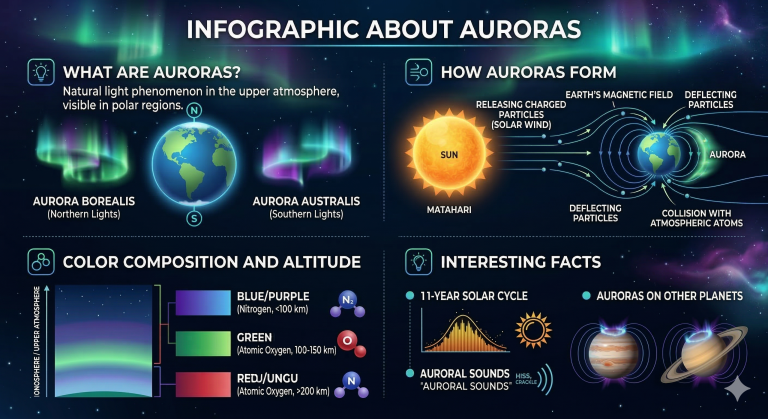
An Aurora, often referred to as Polar Lights, is a natural optical phenomenon that produces shimmering displays of light in a planet’s ionosphere. It is one of the most spectacular visual displays in astronomy, resulting from the interaction between a planet’s atmosphere and the solar wind.
How Auroras Form (Mechanism)
The process of an aurora involves a complex interaction between the Sun, Earth’s magnetic field (magnetosphere), and gases in the atmosphere.
Solar Wind: The Sun constantly releases charged particles (electrons and protons) into space through its corona.
Magnetosphere as a Shield: As these particles approach Earth, they are blocked by Earth’s magnetic field. Most particles are deflected, but some become trapped and are funneled toward the magnetic poles (North and South) along magnetic field lines.
Atomic Excitation: At the poles, these charged particles collide with gas atoms in the upper atmosphere (thermosphere and ionosphere). This collision transfers energy to the gas atoms, putting them in an “excited state.”
Photon Release: When these atoms return to their stable state (de-excitation), they release energy in the form of light (photons). Billions of these collisions create the glowing curtains of light we see.
Color Spectrum and Atmospheric Chemistry
The color of an aurora is determined by the type of gas being struck and the altitude where the collision occurs:
Green (Most Common): Produced by Oxygen atoms at altitudes of about 100–150 km. The human eye is most sensitive to this color.
Red: Also produced by Oxygen, but at much higher altitudes (above 200 km) where oxygen concentration is lower.
Blue or Purple: Results from ionized Nitrogen molecules. This color usually appears at the lower edges of the auroral curtains.
Pink/Yellow: A mixture of oxygen and nitrogen emissions occurring during intense solar activity.
Classification by Location
Based on geographical location, auroras are divided into two primary names:
Aurora Borealis: Occurs in the Northern Hemisphere (often called the Northern Lights). The name is derived from “Aurora” (Roman Goddess of Dawn) and “Boreas” (Greek North Wind).
Aurora Australis: Occurs in the Southern Hemisphere (Southern Lights). This phenomenon is identical to the Borealis but is mostly visible from Antarctica or the southern tips of South America and Australia.
Fascinating Astronomical Facts
Solar Cycle: Aurora intensity follows the 11-year Solar Cycle. During the Solar Maximum (predicted to occur around 2024–2026), the frequency and strength of auroras increase significantly.
Auroras on Other Planets: Earth is not the only place where auroras occur. Planets with strong magnetic fields like Jupiter and Saturn have massive, powerful auroras that can even be detected in the ultraviolet and infrared spectrums.
Auroral Sounds: Some reports and studies suggest a faint “hissing” or “crackling” sound during very active auroras, thought to be caused by electrostatic discharges (the corona effect) in lower layers of the atmosphere.
Amir maulana – SKYWORLD
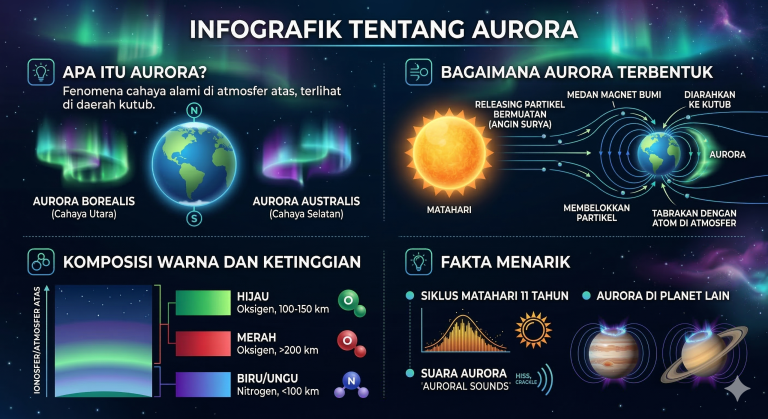
Aurora, atau yang sering disebut sebagai Cahaya Kutub, adalah fenomena optik alami yang menghasilkan pancaran cahaya yang menyala-nyala di lapisan ionosfer sebuah planet. Fenomena ini merupakan salah satu pertunjukan visual paling spektakuler dalam astronomi yang terjadi akibat interaksi antara atmosfer planet dengan angin surya.
Mekanisme Terjadinya Aurora
Proses terbentuknya aurora melibatkan interaksi kompleks antara Matahari, medan magnet Bumi (magnetosfer), dan gas di atmosfer.
Angin Surya (Solar Wind): Matahari terus-menerus melepaskan partikel bermuatan (elektron dan proton) ke luar angkasa melalui korona.
Magnetosfer sebagai Perisai: Ketika partikel ini mendekati Bumi, mereka dihadang oleh medan magnet Bumi. Sebagian besar partikel dibelokkan, namun sebagian terjebak dan diarahkan menuju kutub magnet (Utara dan Selatan) melalui garis-garis medan magnet.
Eksitasi Atom: Di kutub, partikel bermuatan tersebut menabrak atom-atom gas di atmosfer atas (termosfer dan ionosfer). Tabrakan ini memberikan energi pada atom gas tersebut (keadaan tereksitasi).
Pelepasan Foton: Saat atom-atom tersebut kembali ke keadaan stabil (de-eksitasi), mereka melepaskan energi dalam bentuk energi cahaya (foton). Jutaan tabrakan inilah yang menciptakan tirai cahaya yang kita lihat.
Spektrum Warna dan Kimia Atmosfer
Warna aurora ditentukan oleh jenis gas yang berinteraksi dengan partikel bermuatan dan ketinggian tempat tabrakan itu terjadi:
Hijau (Paling Umum): Dihasilkan oleh atom Oksigen pada ketinggian sekitar 100–150 km. Mata manusia paling sensitif terhadap warna ini.
Merah: Juga dihasilkan oleh Oksigen, tetapi pada ketinggian yang jauh lebih tinggi (di atas 200 km) di mana konsentrasi oksigen lebih rendah.
Biru atau Ungu: Muncul dari molekul Nitrogen yang terionisasi. Warna ini biasanya terlihat di bagian bawah tirai aurora yang lebih rendah.
Merah Muda/Kuning: Merupakan campuran antara emisi oksigen dan nitrogen saat aktivitas matahari sangat kuat.
[Image showing the colors of aurora and their corresponding altitudes in the atmosphere]
Klasifikasi Berdasarkan Lokasi
Berdasarkan letak geografisnya, aurora dibagi menjadi dua nama utama:
Aurora Borealis: Terjadi di belahan Bumi utara (sering disebut Northern Lights). Nama ini diambil dari “Aurora” (Dewi Fajar Roma) dan “Boreas” (Angin Utara Yunani).
Aurora Australis: Terjadi di belahan Bumi selatan (Southern Lights). Fenomena ini identik dengan Borealis tetapi sering kali hanya terlihat dari Antartika atau ujung selatan Amerika Selatan dan Australia.
Fakta Astronomi Menarik
Siklus Matahari: Intensitas aurora mengikuti Siklus Matahari 11 tahunan. Saat berada di puncak Solar Maximum (seperti yang diprediksi terjadi di sekitar tahun 2024–2026), frekuensi dan kekuatan aurora meningkat drastis.
Aurora di Planet Lain: Bumi bukan satu-satunya tempat terjadinya aurora. Planet dengan medan magnet kuat seperti Jupiter dan Saturnus memiliki aurora yang jauh lebih masif dan kuat, bahkan dapat dideteksi dalam spektrum ultraviolet dan inframerah.
Suara Aurora: Beberapa laporan dan penelitian menunjukkan adanya suara “desis” atau “retakan” halus saat aurora sangat aktif, yang diduga disebabkan oleh pelepasan muatan listrik (efek korona) di lapisan atmosfer yang lebih rendah.
Amir Maulana – SKYWORLD