
Here is the complete information about comets translated into English:
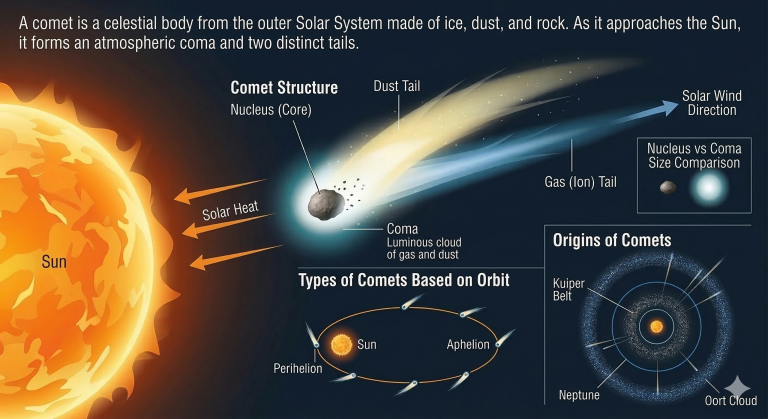
Comets are celestial bodies that orbit the Sun in highly elongated (elliptical) paths. Often nicknamed “dirty snowballs,” comets consist of a frozen mixture of ice (water, ammonia, methane, carbon dioxide), dust, and rocks.
Below is the comprehensive information regarding the structure, types, and origins of comets:
1. Structure of a Comet
As a comet approaches the Sun, heat causes the ice to sublimate (change directly into gas), creating these distinctive structures:
Nucleus: The solid, frozen central part. Usually only a few kilometers in size, yet it contains almost all of the comet’s mass.
Coma: A giant cloud of gas and dust surrounding the nucleus. The coma forms when the ice in the nucleus begins to evaporate due to solar heat.
Tail: The most spectacular part, which can stretch for millions of kilometers. There are two types:
Ion (Gas) Tail: Bluish in color, straight, and composed of ionized gases. This tail always points directly away from the Sun, pushed by the solar wind.
Dust Tail: Yellowish-white, wider, and tends to curve along the comet’s orbital path.
Hydrogen Envelope: A vast but very thin layer of hydrogen surrounding the coma, invisible to the naked eye.
2. Types of Comets
Comets are typically classified based on the length of time they take to orbit the Sun:
| Comet Type | Orbital Period | Origin | Famous Example |
| Short-Period | < 200 years | Kuiper Belt (beyond Neptune’s orbit) | Halley’s Comet (±76 years), Encke |
| Long-Period | > 200 years | Oort Cloud (outermost edge of Solar System) | Hale-Bopp, Hyakutake |
| Non-Periodic | Passes only once | Interstellar Space / Deep Oort Cloud | Comet ISON, McNaught |
3. Unique Cometary Orbits
Unlike planets, which have nearly circular orbits, comets have highly eccentric (oval) orbits.
Perihelion: The point closest to the Sun, where the comet is most active and its tail is longest.
Aphelion: The point furthest from the Sun, where the comet is just a dark, inactive ball of frozen ice.
4. Origins: Where Do They Come From?
Most comets originate from two cold regions at the edge of the Solar System:
Kuiper Belt: A disk-shaped region beyond the orbit of Neptune. Comets from here tend to have orbits that align with the planets’ orbits.
Oort Cloud: A giant spherical “shell” surrounding the entire Solar System at an immense distance (up to tens of thousands of times the distance from Earth to the Sun). Comets from here can appear from any direction in the sky.
5. Why Are Comets Important?
Scientists are keenly interested in studying comets because they are “time capsules” from the formation of the Solar System about 4.6 billion years ago. There is also a theory suggesting that ancient comet impacts brought water and organic molecules to Earth, which helped spark the emergence of life.
Amir Maulana – SKYWORLD
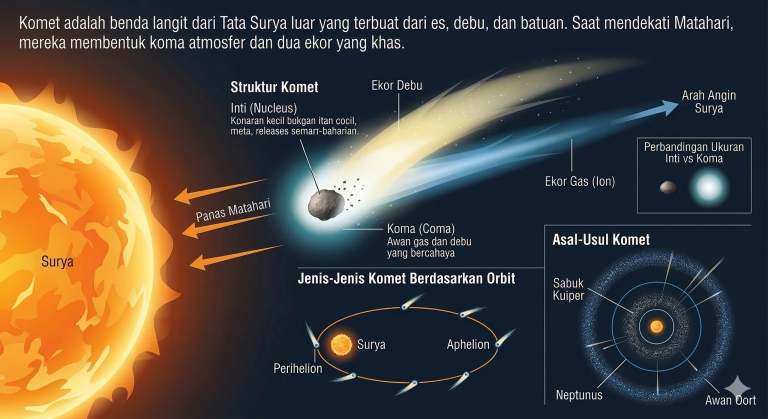
Komet adalah benda langit yang mengorbit Matahari dengan lintasan yang sangat lonjong (elips). Sering dijuluki sebagai “bola salju kotor”, komet terdiri dari campuran es beku (air, amonia, metana, karbon dioksida), debu, dan bebatuan.
Berikut adalah informasi lengkap mengenai struktur, jenis, dan asal-usul komet:
1. Struktur Komet
Saat komet mendekati Matahari, panas menyebabkan es menyublim (berubah langsung menjadi gas), menciptakan struktur khas berikut:
Inti (Nucleus): Bagian pusat yang padat dan beku. Biasanya hanya berukuran beberapa kilometer, namun mengandung hampir seluruh massa komet.
Koma (Coma): Awan gas dan debu raksasa yang menyelimuti inti. Koma terbentuk ketika es di inti mulai menguap karena panas Matahari.
Ekor (Tail): Bagian paling spektakuler yang bisa membentang jutaan kilometer. Ada dua jenis ekor:
Ekor Gas (Ion): Berwarna kebiruan, lurus, dan terdiri dari gas yang terionisasi. Ekor ini selalu menunjuk tepat menjauhi Matahari karena didorong oleh angin surya.
Ekor Debu: Berwarna putih kekuningan, lebih lebar, dan cenderung melengkung mengikuti jalur orbit komet.
Selubung Hidrogen: Lapisan hidrogen yang sangat luas namun sangat tipis di sekeliling koma, tidak terlihat oleh mata telanjang.
2. Jenis-Jenis Komet
Komet biasanya diklasifikasikan berdasarkan lamanya waktu yang dibutuhkan untuk mengorbit Matahari:
| Jenis Komet | Periode Orbit | Asal Usul | Contoh Terkenal |
| Periode Pendek | < 200 tahun | Sabuk Kuiper (di luar orbit Neptunus) | Komet Halley (±76 tahun), Encke |
| Periode Panjang | > 200 tahun | Awan Oort (tepi terluar Tata Surya) | Komet Hale-Bopp, Hyakutake |
| Non-Periodik | Hanya lewat sekali | Luar Tata Surya / Awan Oort jauh | Komet ISON, McNaught |
3. Orbit Komet yang Unik
Berbeda dengan planet yang orbitnya hampir melingkar, komet memiliki orbit yang sangat eksentrik (lonjong).
Perihelion: Titik terdekat dengan Matahari, di mana komet paling aktif dan ekornya paling panjang.
Aphelion: Titik terjauh dari Matahari, di mana komet hanya berupa bola es beku yang gelap dan tidak aktif.
4. Asal-Usul: Dari Mana Mereka Datang?
Sebagian besar komet berasal dari dua wilayah dingin di pinggiran Tata Surya:
Sabuk Kuiper: Wilayah berbentuk cakram di luar orbit Neptunus. Komet dari sini cenderung memiliki orbit yang searah dengan orbit planet.
Awan Oort: “Cangkang” bola raksasa yang menyelimuti seluruh Tata Surya pada jarak yang sangat jauh (hingga puluhan ribu kali jarak Bumi ke Matahari). Komet dari sini bisa muncul dari arah mana pun di langit.
5. Mengapa Komet Penting?
Para ilmuwan sangat tertarik mempelajari komet karena mereka adalah “kapsul waktu” dari masa pembentukan Tata Surya sekitar 4,6 miliar tahun lalu. Ada juga teori yang menyatakan bahwa hantaman komet di masa purba membawa air dan molekul organik ke Bumi, yang membantu memicu munculnya kehidupan.
Amir Maulana – SKYWORLD