
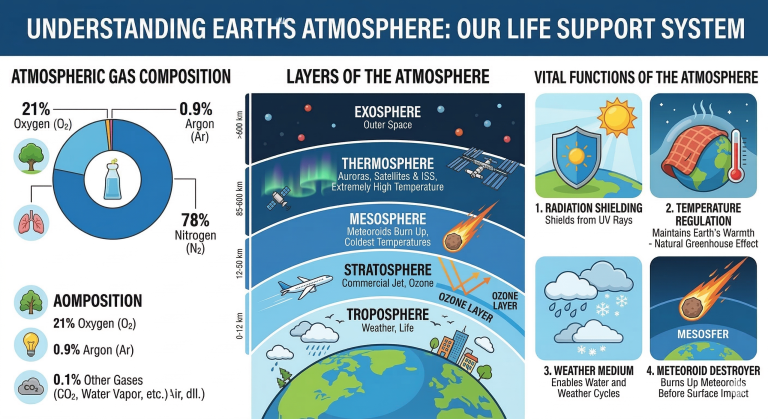
Earth’s atmosphere is a layer of gases that envelops our planet and is held in place by gravity. Without this layer, Earth would be a barren rock, scorched by solar radiation during the day and frozen at night. Simply put, the atmosphere is our natural “life-support system.”
Here is the complete breakdown of the atmosphere’s composition, layers, and functions:
1. Atmospheric Gas Composition
The air we breathe isn’t just oxygen. In fact, our atmosphere consists of a mixture of various gases in distinct proportions:
| Gas | Percentage | Primary Function |
| Nitrogen ($N_2$) | 78% | Stabilizes pressure and supports plant growth. |
| Oxygen ($O_2$) | 21% | Essential for living things to breathe. |
| Argon (Ar) | 0.9% | An inert noble gas (unreactive). |
| Carbon Dioxide ($CO_2$) | 0.04% | Crucial for photosynthesis and temperature regulation (greenhouse effect). |
| Water Vapor & Others | Variable | Responsible for clouds, rain, and weather patterns. |
2. Layers of the Atmosphere
The atmosphere is divided into five main layers based on temperature changes relative to altitude:
Troposphere (0 – 12 km)
This is the layer where we live. Almost all weather phenomena (rain, lightning, clouds) occur here. The higher you climb, the colder the temperature becomes.
Stratosphere (12 – 50 km)
This is where jet planes fly to avoid weather turbulence. This layer contains the Ozone ($O_3$) layer, which absorbs most of the sun’s harmful ultraviolet (UV) radiation. Unlike the troposphere, the temperature here actually rises with altitude due to UV absorption.
Mesosphere (50 – 85 km)
A protective “shield” against space debris. Most meteors burn up in this layer due to friction with the air. It is the coldest layer of Earth’s atmosphere.
Thermosphere (85 – 600 km)
Although the air is very thin, temperatures here can reach 1,500°C because it absorbs extreme UV and X-ray radiation. The International Space Station (ISS) orbits in this layer. This is also where the beautiful Aurora phenomena occur.
Exosphere (> 600 km)
The outermost layer that gradually merges into the vacuum of space. Gas particles here are so sparse that atoms can travel hundreds of kilometers without colliding with one another.
3. Vital Functions of the Atmosphere
The atmosphere isn’t just “empty air”; it performs these heavy-duty tasks:
Radiation Filter: Protects us from solar UV radiation that can cause skin cancer and ecosystem damage.
Temperature Regulator: Through the natural greenhouse effect, the atmosphere keeps Earth warm (averaging 15°C). Without it, Earth’s temperature could drop to -18°C.
Weather Medium: Distributes water across the Earth’s surface through the hydrological cycle (evaporation and rain).
Meteor Destroyer: Prevents small space rocks from directly striking the Earth’s surface by burning them up upon entry.
Our atmosphere may seem thick, but compared to the size of the Earth, it is actually very thin—much like the skin of an apple. Therefore, maintaining air quality and the ozone layer is vital for our survival.
Amir Maulana – SKYWORLD
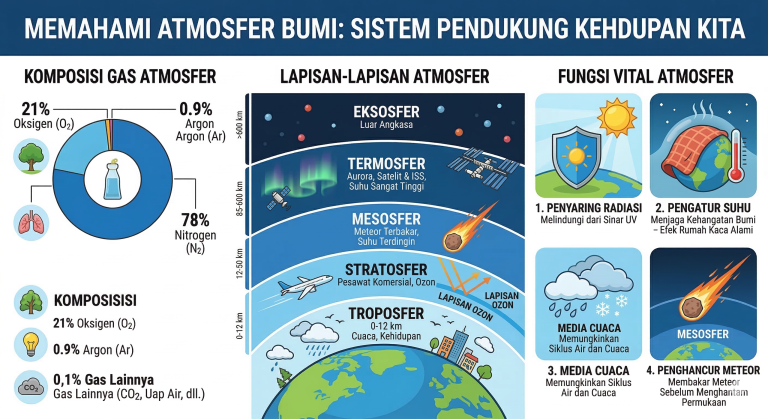
tmosfer Bumi adalah lapisan gas yang menyelimuti planet kita dan tertahan oleh gravitasi. Tanpa lapisan ini, Bumi hanyalah batu gersang yang terpanggang radiasi matahari di siang hari dan membeku di malam hari. Singkatnya, atmosfer adalah “sistem pendukung kehidupan” alami kita.
Berikut adalah rincian lengkap mengenai komposisi, lapisan, dan fungsi atmosfer:
1. Komposisi Gas di Atmosfer
Udara yang kita hirup bukan hanya oksigen. Faktanya, atmosfer kita terdiri dari campuran berbagai gas dengan proporsi yang cukup kontras:
| Gas | Persentase | Fungsi Utama |
| Nitrogen ($N_2$) | 78% | Menstabilkan tekanan dan mendukung pertumbuhan tanaman. |
| Oksigen ($O_2$) | 21% | Dibutuhkan makhluk hidup untuk bernapas. |
| Argon (Ar) | 0,9% | Gas mulia yang bersifat inert (tidak bereaksi). |
| Karbon Dioksida ($CO_2$) | 0,04% | Penting untuk fotosintesis dan mengatur suhu (efek rumah kaca). |
| Uap Air & Lainnya | Bervariasi | Membentuk awan, hujan, dan cuaca. |
2. Lapisan-Lapisan Atmosfer
Atmosfer dibagi menjadi lima lapisan utama berdasarkan perubahan suhu seiring dengan ketinggian:
Troposfer (0 – 12 km)
Ini adalah lapisan tempat kita tinggal. Hampir semua fenomena cuaca (hujan, petir, awan) terjadi di sini. Semakin tinggi kamu mendaki, suhunya justru semakin dingin.
Stratosfer (12 – 50 km)
Di sinilah pesawat jet terbang agar terhindar dari turbulensi cuaca. Lapisan ini mengandung Ozon ($O_3$) yang menyerap sebagian besar radiasi ultraviolet (UV) berbahaya dari matahari. Berbeda dengan troposfer, suhu di sini justru naik seiring ketinggian karena penyerapan radiasi UV.
Mesosfer (50 – 85 km)
“Perisai” pelindung dari benda luar angkasa. Kebanyakan meteor akan terbakar habis di lapisan ini karena gesekan dengan udara. Ini adalah lapisan terdingin di atmosfer Bumi.
Termosfer (85 – 600 km)
Meskipun udaranya sangat tipis, suhu di sini bisa mencapai 1.500°C karena menyerap radiasi sinar-X dan UV ekstrem. Stasiun Ruang Angkasa Internasional (ISS) mengorbit di lapisan ini. Di sini juga terjadi fenomena Aurora yang indah.
Eksosfer (> 600 km)
Lapisan terluar yang perlahan-lahan menyatu dengan ruang angkasa hampa. Gas di sini sangat jarang sehingga atom bisa menempuh ratusan kilometer tanpa menabrak satu sama lain.
3. Fungsi Vital Atmosfer bagi Bumi
Atmosfer bukan sekadar “udara kosong”, ia menjalankan tugas-tugas berat berikut:
Penyaring Radiasi: Melindungi kita dari radiasi UV matahari yang bisa menyebabkan kanker kulit dan kerusakan ekosistem.
Pengatur Suhu: Melalui efek rumah kaca alami, atmosfer menjaga suhu Bumi agar tetap hangat (rata-rata 15°C). Tanpanya, suhu Bumi bisa anjlok hingga -18°C.
Media Cuaca: Mendistribusikan air ke seluruh permukaan Bumi melalui siklus hidrologi (penguapan dan hujan).
Penghancur Meteor: Menghalangi jatuhnya batuan luar angkasa berukuran kecil agar tidak menghantam permukaan Bumi secara langsung.
Atmosfer kita terlihat tebal, tapi jika dibandingkan dengan ukuran Bumi, ia sebenarnya sangat tipis—ibarat kulit pada buah apel. Oleh karena itu, menjaga kualitas udara dan lapisan ozon sangat penting untuk kelangsungan hidup kita.
Amir Maulana – SKYWORLD