
Karang Anyar – Jawa Tengah
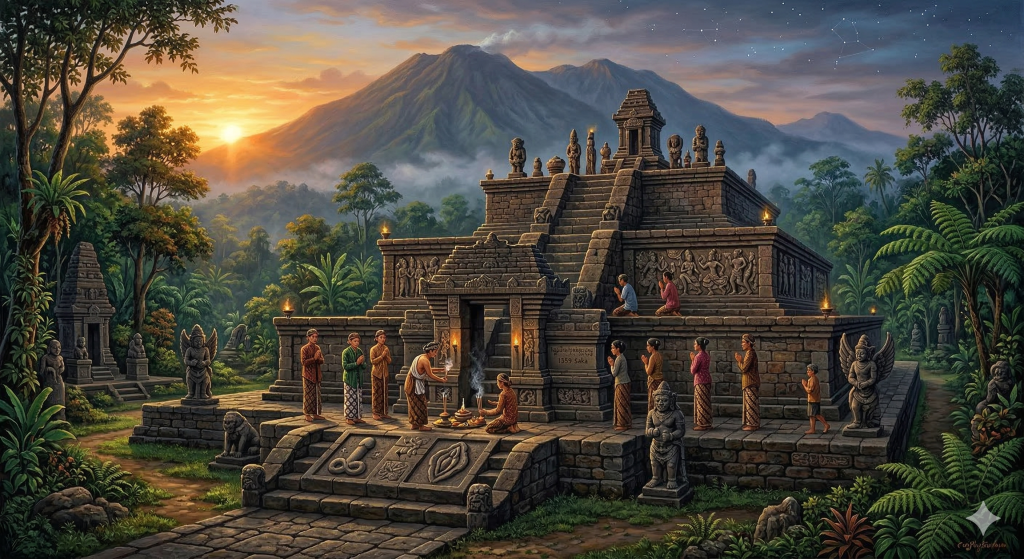
Candi Sukuh is indeed one of the most unique and enigmatic heritage sites in the archipelago. Unlike the magnificent temples left by the Ancient Mataram Kingdom, such as Borobudur or Prambanan, Candi Sukuh has a completely different architecture and atmosphere.
Here is the complete history and fascinating facts about Candi Sukuh in Karanganyar, Central Java:
1. Location and Pyramid-Like Architecture
Candi Sukuh is located in Berjo Village, Ngargoyoso Subdistrict, Karanganyar Regency, Central Java. It sits on the western slope of Mount Lawu at an altitude of about 910 meters above sea level.
The most striking feature of this temple is its shape, which is a truncated step pyramid (trapezoid). This design makes it look remarkably similar to the Mayan pyramids in Central America or prehistoric megalithic structures, straying far from the classic Hindu-Buddhist architectural style that typically towers high like a mountain. The complex consists of three terraced platforms, with the third terrace (the highest peak) serving as the most sacred area.
2. Construction History (Late Majapahit Period)
Candi Sukuh was built in the 15th century AD, specifically during the twilight years of the Majapahit Empire (estimated during the reign of Queen Suhita).
Archaeologists determined its year of construction from several candrasengkala memet (chronograms in the form of coded pictures or carvings) found within the temple complex. These include:
-
On the first gate, there is a relief of a giant devouring a human, symbolizing the phrase “Gapura buta mangan wong”. When converted into numbers, this code points to the year 1359 Saka or 1437 AD.
-
Another chronogram found reads “Gajah wiku anahut buntut”, which refers to the year 1378 Saka or 1456 AD.
During this period, Hindu-Buddhist influence in Majapahit began to wane. Javanese society slowly experienced a revival of local traditions (the prehistoric culture of the archipelago) that focused on the worship of ancestral spirits and the forces of nature. That is why Candi Sukuh is not shaped like a towering spire like Prambanan Temple, but instead returns to the basic form of a step pyramid inherited from the original ancestors of the archipelago.
3. Rediscovery
After the fall of Majapahit, the temple was gradually abandoned, covered in soil, and overgrown with wild plants. Candi Sukuh was only “rediscovered” in the modern era in 1815 by Jeremiah Martin Johnson, a Resident of Surakarta during the British administration.
The British Lieutenant-Governor at the time, Sir Thomas Stamford Raffles, later recorded this discovery in his famous book, The History of Java. Following that, various studies were conducted by Dutch archaeologists, such as Van der Vlis (1842), Verbeek (1889), Knebel (1910), and W.F. Stutterheim (1930). The first restoration of the temple was carried out in 1917 by the Dutch East Indies Antiquities Service and was later continued by the Indonesian government in the 1970s.
4. The Meaning of the Reliefs: Purification (Ruwatan) and Fertility Symbols
Candi Sukuh often attracts attention because it features statues and reliefs that are sexually explicit. However, it is absolutely not an “erotic temple.” Historically and spiritually, Candi Sukuh was built as a sacred place for ruwatan (self-purification or liberation from misfortune).
-
Lingam and Yoni Symbols: On the floor of the temple’s entrance gate, there are carvings of a Lingam and Yoni (male and female reproductive organs) facing each other. Philosophically, these are symbols of fertility, the creation of the universe, and the harmony of life. It is said that in ancient times, anyone who stepped over these carvings was believed to be cleansed of all negative auras before entering the more sacred temple area.
-
The Tale of Sudamala and the Birth of Bima: The narrative reliefs at Candi Sukuh mostly feature epic stories, such as the Sudamala tale (the story of Sadewa successfully freeing Goddess Durga from a curse) and the story of Bima Bungkus. All of these stories share a common thread: the process of soul purification and the liberation of humans from all evil.
Candi Sukuh is essentially a silent witness to the spiritual transition of Javanese society at the end of the Majapahit era—a moment where they embraced their native megalithic ancestral traditions amidst changing times.
Candi Sukuh’s Connection to Outer Space: Fact vs. Myth
The temple’s connection to space-related concepts is actually divided into two perspectives: ancient scientific study (Archaeoastronomy) and pop culture myths (Ancient Aliens).
1. The Scientific Side: Archaeoastronomy and Ancient Cosmology In the discipline of archaeoastronomy (the study of how ancient societies understood the solar system and celestial phenomena), Candi Sukuh features a spatial layout oriented towards celestial bodies.
-
Solar Orientation: Unlike the majority of temples in Java that face east (the direction of the sunrise), the Candi Sukuh complex was actually built facing west. For the ancient Javanese people at that time, the sun was not just an object at the center of the solar system, but a symbol of a spiritual journey. Facing west symbolizes the end of worldly life and the preparation for the soul’s return to the origin of the universe.
-
Microcosm and Macrocosm: The three terraced levels of Candi Sukuh are a physical representation of cosmic cosmology. The lowest terrace represents the human realm (microcosm), the middle terrace is the transitional realm, and the highest terrace is the spirit realm or macrocosm—the most sacred point closest to the expanse of the sky and the creator of the universe.
2. Popular Myths: Alien Intervention Conspiracy Theories Because its shape is highly unusual for a temple in Java, Candi Sukuh is often linked to extraterrestrial intervention by fans of fringe theories.
-
Pyramid Architecture: There is speculation suggesting that this truncated pyramid was built with the help of extraterrestrial technology, considering its shape is identical to civilizations on other continents separated by oceans. There are even popular science fiction works that use Candi Sukuh as a portal site transmitting mysterious signals into outer space.
-
Winged Human Reliefs: Within the temple complex, there are statues and reliefs of a winged human figure. Many wild theories equate it to the form of an ancient alien race or Anunnaki gods descending from the sky, as seen in Sumerian mythology.
-
The Facts (Debunking the Myth): Of course, this alien theory is a misconception. Archaeological and philological evidence firmly proves that the winged figure is Garuda, a mythological creature serving as a deity’s mount, symbolizing freedom and soul purification (ruwatan). The pyramid shape of this temple is also not an alien blueprint, but rather the genius of its creators returning to their local cultural roots: building stepped platforms to worship ancestral spirits in the highlands.
Candi Sukuh stands as a silent witness to how the ancestors of the archipelago read the cosmos and aligned their architecture with the universe, long before modern astronomy developed.
Amir Maulana – SKYWORLD
Candi Sukuh memang salah satu peninggalan paling unik dan penuh teka-teki di Nusantara. Berbeda dengan candi-candi megah peninggalan Mataram Kuno seperti Borobudur atau Prambanan, Candi Sukuh memiliki arsitektur dan nuansa yang sangat berbeda.
Berikut adalah sejarah lengkap dan fakta-fakta menarik seputar Candi Sukuh di Karanganyar, Jawa Tengah:
1. Lokasi dan Arsitektur ala Piramida
Candi Sukuh terletak di Desa Berjo, Kecamatan Ngargoyoso, Kabupaten Karanganyar, Jawa Tengah. Posisinya berada di lereng barat Gunung Lawu pada ketinggian sekitar 910 meter di atas permukaan laut.
Hal yang paling mencolok dari candi ini adalah bentuknya yang berupa punden berundak terpotong (trapesium). Bentuk ini membuatnya sangat mirip dengan piramida suku Maya di Amerika Tengah atau bangunan-bangunan megalitik prasejarah, sangat jauh dari pakem arsitektur Hindu-Buddha klasik yang biasanya menjulang tinggi menyerupai gunung. Kompleks ini terdiri dari tiga teras berundak, di mana teras ketiga (puncak tertinggi) merupakan area yang paling suci.
2. Sejarah Pembangunan (Masa Akhir Majapahit)
Candi Sukuh dibangun pada abad ke-15 Masehi, tepatnya di masa-masa akhir kejayaan Kerajaan Majapahit (diperkirakan pada masa pemerintahan Ratu Suhita).
Para arkeolog mengetahui tahun pembangunannya dari beberapa candrasengkala memet (kronogram dalam wujud gambar atau ukiran bersandi) yang ditemukan di kompleks candi, antara lain:
-
Pada gapura pertama, terdapat relief raksasa memangsa manusia yang bermakna “Gapura buta mangan wong”. Jika dikonversi menjadi angka, sandi ini menunjuk pada tahun 1359 Saka atau 1437 Masehi.
-
Ditemukan juga sengkalan lain berbunyi “Gajah wiku anahut buntut” yang merujuk pada tahun 1378 Saka atau 1456 Masehi.
Pada periode ini, pengaruh Hindu-Buddha di Majapahit mulai melemah. Masyarakat Jawa perlahan mengalami kebangkitan tradisi lokal (kebudayaan prasejarah Nusantara) yang berfokus pada pemujaan roh leluhur dan kekuatan alam. Itulah sebabnya Candi Sukuh tidak berbentuk menara seperti Candi Prambanan, melainkan kembali ke bentuk dasar punden berundak warisan leluhur asli Nusantara.
3. Penemuan Kembali
Setelah runtuhnya Majapahit, candi ini perlahan ditinggalkan, tertutup tanah, dan dirimbuni tumbuhan liar. Candi Sukuh baru “ditemukan” kembali di era modern pada tahun 1815 oleh Jeremiah Martin Johnson, seorang Residen Surakarta pada masa pemerintahan Inggris.
Gubernur Jenderal Inggris kala itu, Sir Thomas Stamford Raffles, kemudian mencatat penemuan ini dalam bukunya yang sangat terkenal, The History of Java. Setelah itu, berbagai penelitian lanjutan dilakukan oleh para arkeolog Belanda, seperti Van der Vlis (1842), Verbeek (1889), Knebel (1910), dan W.F. Stutterheim (1930). Pemugaran candi pertama kali dilakukan pada tahun 1917 oleh Dinas Purbakala Hindia Belanda dan dilanjutkan oleh pemerintah Indonesia pada era 1970-an.
4. Makna Relief: Ruwatan dan Simbol Kesuburan
Candi Sukuh sering kali menarik perhatian karena memiliki patung dan relief yang vulgar dan eksplisit. Namun, candi ini sama sekali bukan “candi porno”. Secara historis dan spiritual, Candi Sukuh dibangun sebagai tempat suci untuk ruwatan (penyucian diri atau pembebasan dari malapetaka).
-
Simbol Lingga dan Yoni: Di lantai gapura masuk candi, terdapat ukiran Lingga dan Yoni (alat kelamin pria dan wanita) yang berhadapan. Secara filosofis, ini adalah simbol kesuburan, penciptaan alam semesta, dan harmoni kehidupan. Konon, pada zaman dahulu, siapa pun yang melangkahi ukiran ini dipercaya akan tersucikan dari segala aura negatif sebelum memasuki area candi yang lebih suci.
-
Kisah Sudamala dan Kelahiran Bima: Relief-relief naratif di Candi Sukuh banyak mengangkat kisah epik, seperti cerita Sudamala (kisah Sadewa yang berhasil membebaskan Dewi Durga dari kutukan) dan kisah Bima Bungkus. Semua cerita ini memiliki satu benang merah: proses pemurnian jiwa dan pembebasan manusia dari segala keburukan.
Candi Sukuh pada dasarnya adalah saksi bisu dari fase transisi spiritual masyarakat Jawa di penghujung era Majapahit, sebuah momen di mana mereka memeluk kembali tradisi megalitik leluhur Nusantara di tengah arus perubahan zaman.
Kaitan Candi Sukuh dengan Luar Angkasa: Fakta vs Mitos
Koneksi candi ini dengan hal-hal berbau angkasa luar sebenarnya terbagi menjadi dua sudut pandang: kajian ilmiah kuno (Arkeoastronomi) dan mitos budaya pop (Ancient Aliens).
1. Sisi Ilmiah: Arkeoastronomi dan Kosmologi Kuno Dalam disiplin ilmu arkeoastronomi (studi tentang bagaimana masyarakat kuno memahami tata surya dan fenomena langit), Candi Sukuh menyimpan tata letak ruang yang berorientasi pada benda langit.
-
Orientasi Terhadap Matahari: Berbeda dengan mayoritas candi di Jawa yang menghadap ke arah timur (arah matahari terbit), kompleks Candi Sukuh justru dibangun menghadap ke arah barat. Bagi masyarakat Jawa kuno saat itu, matahari bukan sekadar benda di pusat tata surya, melainkan simbol perjalanan spiritual. Menghadap ke barat melambangkan akhir dari kehidupan duniawi dan persiapan kembalinya jiwa ke asal mula alam semesta.
-
Mikrokosmos dan Makrokosmos: Tiga teras berundak pada Candi Sukuh adalah representasi fisik dari kosmologi kosmik. Teras paling bawah mewakili alam manusia (mikrokosmos), teras tengah adalah alam transisi, dan teras tertinggi adalah alam roh atau makrokosmos—titik suci yang paling dekat dengan bentangan langit dan pencipta semesta.
2. Mitos Populer: Teori Konspirasi Campur Tangan Alien Karena bentuknya yang sangat tidak lazim untuk ukuran candi di Jawa, Candi Sukuh sering kali dikaitkan dengan campur tangan makhluk luar angkasa oleh para penggemar teori konspirasi (fringe theories).
-
Arsitektur Piramida: Ada spekulasi yang menyebutkan bahwa bentuk piramida terpancung ini dibangun dengan bantuan teknologi luar angkasa, mengingat bentuknya yang identik dengan peradaban benua lain yang terpisah samudera. Bahkan, ada karya fiksi ilmiah populer yang menjadikan Candi Sukuh sebagai lokasi portal pemancar sinyal misterius ke luar angkasa.
-
Relief Manusia Bersayap: Di kompleks candi ini terdapat patung dan relief sosok manusia bersayap. Banyak teori liar yang menyamakannya dengan wujud ras alien kuno atau dewa Anunnaki yang turun dari langit seperti dalam mitologi Sumeria.
-
Faktanya (Meluruskan Mitos): Tentu saja, teori alien ini adalah miskonsepsi. Bukti arkeologis dan filologis dengan tegas membuktikan bahwa sosok bersayap itu adalah Garuda, makhluk mitologi tunggangan dewa yang melambangkan kebebasan dan pemurnian jiwa (ruwatan). Bentuk piramida candi ini juga bukan cetak biru makhluk asing, melainkan kejeniusan pembuatnya yang kembali ke akar budaya lokal: membangun punden berundak berundak untuk memuja roh nenek moyang di dataran tinggi.
Candi Sukuh adalah saksi bisu bagaimana leluhur di Nusantara membaca kosmos dan menyelaraskan arsitektur mereka dengan alam semesta, jauh sebelum astronomi modern berkembang.
Amir Maulana – SKYWORLD